

“You’ve been reading too much science fiction. No, this is no parallel world. You don’t have 1984 over there and 1Q84 branching off over here and the two worlds running along parallel tracks. The year 1984 no longer exists anywhere. For you and for me, the only time that exists anymore is this year of 1Q84”
– Leader (572)
Hello! As you can probably guess by the page count at the top, I’ve spent quite a long time reading this book and have had a lot of fun with it. I’m excited to finally write about Murakami’s ambitious, not-too-focused, monster of a novel. It’s the kind of book where it’s understandably very easy to lose track of what you read 400 pages earlier, so hopefully this will also serve as a good exercise to help wrap my head around the book.
Non-Spoiler:
1Q84 is a book that is trying to be a lot of different things. I’m not sure if it’s right to say this book is Murakami’s most ambitious work, but it’s definitely his longest. It centers around two characters, Tengo and Aomame, with the author having each chapter alternate from their third-person perspective. Tengo is a mild-mannered cram-school teacher aspiring to become a novelist, while Aomame is a fitness instructor with an involved side-job. Featuring a runaway girl, a wealthy dowager, a new best-selling short story, parallel universes, little people, two moons, NHK fee collectors and the occult, the book throws a lot at the reader…
The book is also filled with many classic “Murakami-isms,” like long-winded classical/jazz music descriptions, sex and magical-realism elements. For context, this is only my third book by the author, after Wild Sheep Chase and Wind Up Bird Chronicle. In my opinion, the latter is probably a better and tighter story than 1Q84. With all Murakami books, I always get the feeling that the author’s writing is dancing on the line of being incredibly insightful or a series of long-winded tangents and observations that really amount to empty calories. The likely answer is that some of his weaker writing includes a little of both. With the length of this book, there are definitely some striking observations and also threads that never feel truly fleshed out. I wouldn’t say this is the best Murakami book to start with, but if you like his style and have read some of his other stuff, then 1Q84 is definitely worth giving a shot.

Spoiler:
Parallel Universes and the Process of Writing
The taxi’s radio was tuned to a classical FM broadcast. Janacek’s Sinfonietta – probably not the ideal music to hear in a taxi caught in traffic…. The middle-aged driver…stared straight ahead… like a veteran fisherman standing in the bow of his boat, reading the ominous confluence of two currents
– Page 1
One of the primary focuses of the book is the existence of two parallel universes, 1984 and 1Q84. The former leader of Sakigake put it best in the quote referenced at the top of essay where he says there are “two worlds existing on parallel tracks.” The main character’s lives become increasingly complicated and intertwined after the first chapter in the book, where Aomame gets out of the taxi mentioned in the above quote and climbs down the highway’s emergency escape stairwell. Murakami makes clear that at this exact point the novel splits off the tracks of 1984 and enters into 1Q84. After all, it’s precisely after Aomame emerges from the stairwell that she notices the policeman with a completely different uniform on. The uniform, similar to the moon later on, is different from what Aomame originally knows it to be, serving as a signal to both her and the readers that something is different in this world.
It’s interesting to me that this split in universes occurs right after Janacek’s Sinfonietta plays in the car. As I mentioned in the non-spoiler section, Murakami loves to muse about classical music in his books; it’s almost a signifier that you’ve entered into his universe. It then seems fitting that the opening scene, right before Aomame enters into the universe of 1Q84, starts with a broadcast of this classical piece. Murakami is signaling to the reader that you’ve entered into 1Q84. And it’s not just the reader that’s entered into this new world. Aomame and Tengo will soon understand that the tracks have also split for them; they’ve entered into this new world with the reader at the same time. The taxi driver, who acts in an almost god-like role, can see the split in the universe occurring, as the “fisherman” reading the “confluence of two currents.”
Murakami then further complicates this whole thing by suggesting that Tengo is the one actively creating the universe of 1Q84. This becomes clear when Tengo first notices the second moon in the sky.
No doubt about it: there were no moons.
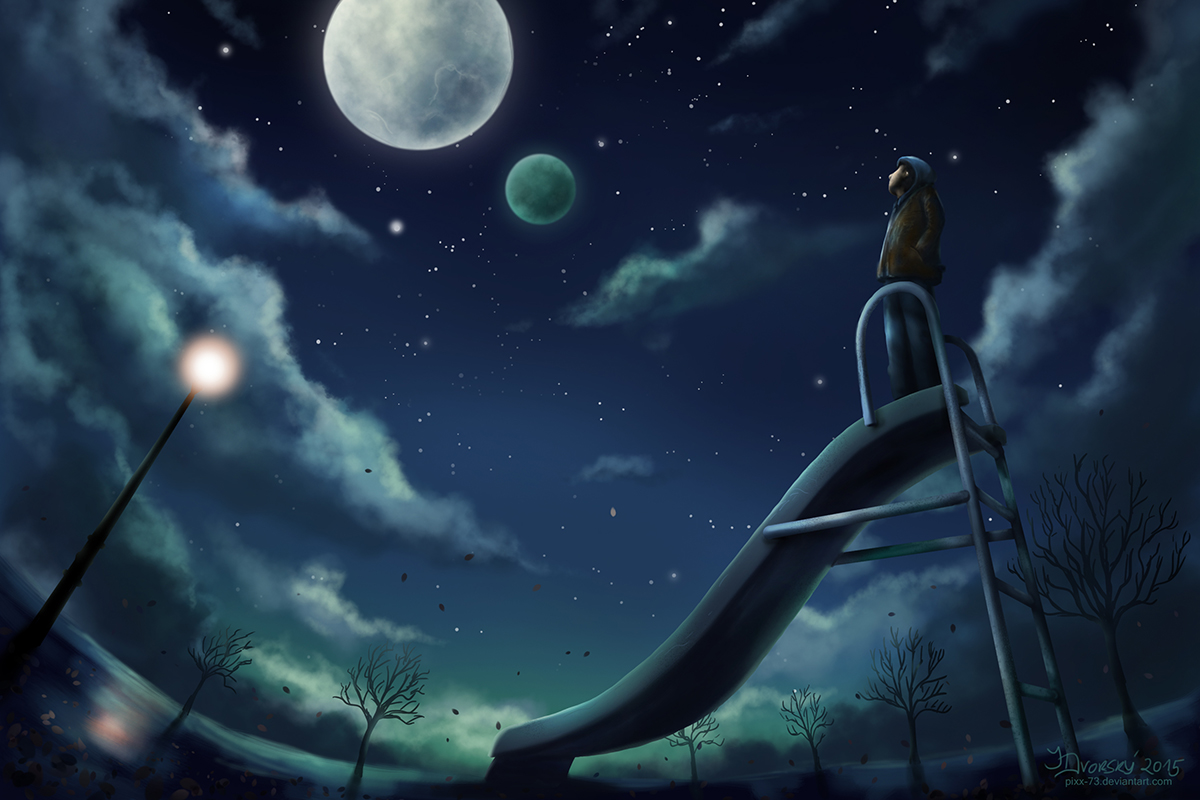
One was the moon that had always been there, and the other was a far smaller, greenish moon, somewhat lopsided in shape, and much less bright...
“Damn, it’s the same as in Air Chrysalis! A world with two moons hanging in the sky side by side…”
Tengo was the one who wrote those words. Following Komatsu’s advice, he had made his description of the new moon as concrete and detailed as possible. It was the part on which he had worked the hardest. The look of the new moon was almost entirely Tengo’s creation.
This can’t be, Tengo thought. What kind of reality mimics fictional creations?
– 684
Tengo, the full-time cram school teacher, begins this novel by taking on the assignment of re-writing the novel Air Chrysalis. Based on the real life experiences of a young-girl, Fuka Eri, and her manuscript, the main character spends the first part of 1Q84 recreating her work, filling in the gaps with his own creative direction when necessary. However, during the middle portion of the book, he leaves a neighborhood bar and wanders into small playground, where first notices the two moons in the sky. As leader said in the novel, the second moon signifies the presence of the alternate universe, 1Q84.
“Correct: two moons. That is the sign that the track has been switched. That is how you can tell the two worlds apart.”
– Leader (577)
The main character’s observation that “the look of the new moon was almost entirely (his) creation,” suggests that elements of the universe, 1Q84, were of his own creation. Murakami is almost using Tengo as a stand-in for himself. To Murakami, a writer creates and sets the rules of the universe he imagines, where the only limit is how “concrete and detailed” his descriptions are. Authors use main characters as stand-ins for themselves all the time. Tolstoy’s Levin in Anna Karenina and Pierre in War and Peace both serve as fictional versions of author. However, unlike Tolstoy, Murakami’s stand-in of Tengo is less a reflection of the author’s personality or world view, and seems to be part of a broader reflection of the writer’s role in making a story. (As an aside, I loved Tamaru re-working Tolstoy’s famous “all happy families are the same, but all unhappy families are different in their own way” line at the end of the novel)
In 1Q84, the writer is both Murakami and Tengo, with both having the ability to take characters and readers into this alternate world. Aomame comes to this same conclusion during her conversation with leader when she asks, “are you telling me that I was transported into this other world of 1Q84 by Tengo’s storytelling ability – or, as you put it, by the power as a Receiver?” – Aomame (585)
What I find both interesting and a bit annoying is that while Tengo seems to have all the power here, as both someone who creates and transports people into this new universe, he also spends the majority of the book coming across as a completely passive character. The only reason he gets involved in writing Air Chrysalis is because of his editor, Komatsu’s, almost comical insistence. In his sexual relationship with a woman 10 years his senior, she holds almost all the cards (only she can call him and set the terms of their meet ups). He agrees to go along with Fuka Eri’s guardian’s high-risk plan to figure out what’s happened in Sakigake by publishing the novel.
But a narrative takes its own direction, and continues on, almost automatically. And whether he liked it or not, Tengo was a part of that world. To him this was no longer a fictional world. This was the real world, where red blood spurts out when you slice open your skin with a knife. And in the sky in this world, there were two moons, side by side.
– 999
I think the quote above does a good job bridging Tengo’s passive personality with his power as a writer/creator. To someone like Murakami, the “narrative” is such a powerful force as a writer that no matter what you may want or feel, it has the ability to take you and the reader to unexpected places. It can even transport you to a completely new universe, like the world of 1Q84. Even if Tengo or the audience might want something different. Whether it’s 1Q84 or a cat town (Tengo’s version of an alternate universe), we often can find ourselves in strange places or circumstances. Most people will naturally fight the direction of a new or changing current, but the main characters find the most success in this book when they finally learn to accept this place with “two moons, side by side” as “the real world.” It’s no coincidence that Tengo and Aomame are able to leave 1Q84 after they embrace under the two moons, the ultimate signifier of the parallel universe. Once you finally accept that the narrative has taken you to a new place, it then becomes possible to finally leave. Eventually, you need to leave the 1Q84. Even if you are the one that created it.
Wrapping Up
I had a lot of fun reading 1Q84, but the first and second section are definitely stronger than the third. When I look back at it, I don’t think 1Q84 is actually that great. There are just too many themes and threads throughout the novel that don’t become fully realized. The one character who I did think had a rather full narrative arc was Ushikawa. His character and ultimate death are what linger with me the most after reading the novel, which is funny because this is the first time I’m actually mentioning him in this review. I think he deserves his own write up at some point, and maybe after a little time away from this behemoth of a novel, I’ll get to writing about him. The thing that always hurt the book for me is that I was never completely amazed with Tengo as a character. He feels like a redux of Toru Okada from Wind Up Bird Chronicle, but with the problem in this book being that the third-person style of writing made feel more closed off from Tengo.
1Q84 was definitely an interesting read, and I’m genuinely excited to read more of Murakami’s work. I think some of his characters, like Tamaru and Ushikawa, are incredibly fun and well-written. There are some passages, like when Aomame meets the dowager in the butterfly den, that still feel like fully realized scenes in my mind. There is some slack that needs to be cut out of the book, but 1Q84 is very much a ride that I enjoyed.

 Coc0na's Pure Illusion