
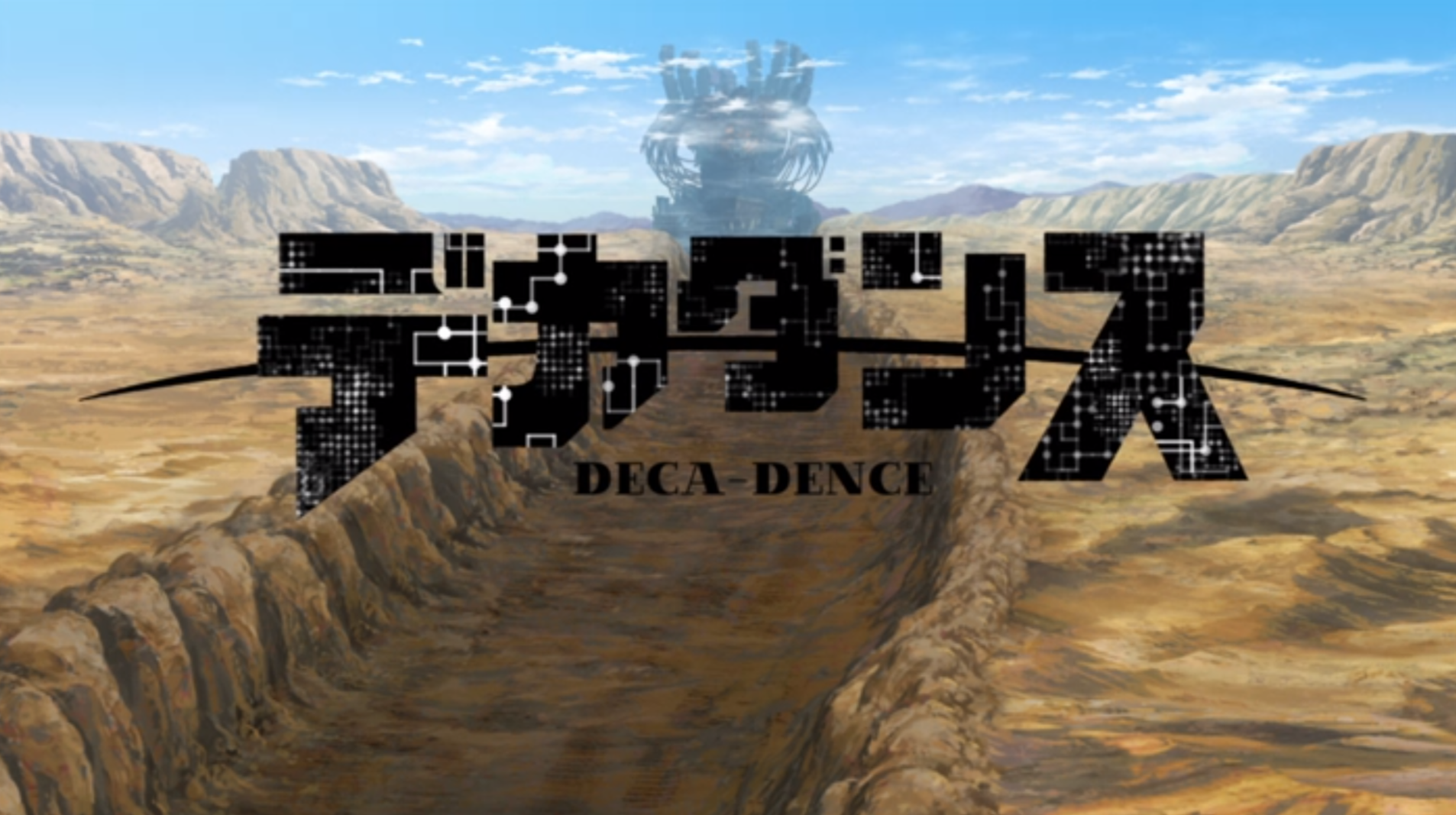
“It is easier to imagine the end of the world than it is to imagine the end of capitalism” – Mark Fisher
If you’ve watched the show Deca-Dence, then it probably comes at no surprise that I wanted to pair my review of this anime with a book about capitalism. I also wanted to put a quick disclaimer at the top of the article. When I was doing some quick research on Deca-Dence, I found a youtuber that did a similar comparison piece on the two works: https://www.youtube.com/watch?v=3Aa-i8eo8mo. I’m not sure the video format is the best way to present a concise argument about the two works, but Weeb Revolution definitely has a good grasp of the subject matter and props to him for beating me to the punch on it.
Non-spoiler:
Deca-Dence

Deca-Dence is the first original anime by Studio Nut and directed by Yuzuru Tachikawa. Best known for Mob Psycho 100 and Death Billiards, Tachikawa is one of the few current directors who consistently is using different animation techniques to push the narrative and themes of his story. Death Billiards proved he could create, produce and direct a deeply empathetic story, while Mob Psycho 100 put him on the map as the director to be watching right now.
Deca-Dence delivers on all fronts. With great art direction, two well-written main characters, and an incredibly interesting world, this show had an ambitious start and somehow stuck the landing perfectly. This show is also probably the successor to Gurren Laggan that people have always been waiting for. Kill a Kill and Darling in the Franxx were both initially thought to be that show, teasing incredibly ambitious universes, but ultimately fell flat on their faces when it came to having good characters and a semi-coherent plot (that last point might be a bit too harsh on Kill La Kill). But, Deca-Dence is able to tell a powerful story about what it ultimately means to be a human, all while doing it with post-apocalyptic setting, evil mega-corporations, cyborgs, and monster-of-the-week style fights. This show definitely got slept on because it was a Hulu exclusive, which is a shame, but if you haven’t seen it, I would highly recommend that you do!
Capitalist Realism: Is There No Alternative?
Mark Fisher’s famous Capitalist Realism, published in the immediate wake of the 2008 banking crisis, is an introductory book of political philosophy that defines a framework for how society views its current economic governance and then dives into the negative effects of it. The point of Fisher’s book is to get those who aren’t normally interested in diving into deep political and philosophical thinking to, well, start thinking more about that kind of stuff… On that front, he greatly succeeded. The book, unlike many of the works it references, comes in at a very lean 81 pages and is riddled with pop culture references. In one passage, Fisher reference the Jason Bourne film series to frame his point on narrative and formal memory in the postmodern world. I’m not going to pretend that I’m some Zizek expert, so this method of storytelling made it a lot more accessible for me.
However, after reading this book, it’s clear that it was largely a reaction to the 2008 banking crisis and the subsequent bailout. And that makes sense. The banking crisis might be the most consequential event of this millennia so far, even more so than Bush vs. Gore, 9/11, the Iraq War and the 2016 Presidential election. The financial meltdown called into question the legitimacy of the post-World War II order. It likely cost Obama the ability to do anything meaningful on the legislative side after the 2010 mid-term elections and led to the resurgence of various far-right political movements in Europe, permanently hurting the EU experiment, and other countries (see Brazil and India). These are worthwhile things to write about, but still, I do feel that it serves to date the book in a way that I don’t think is helpful. So much has happened to our country and world since then, and while the underlying problems of capitalism that Fisher discusses are still very apparent, particularly when it comes to climate issues, this book could use an update.
I’m not qualified to talk about Fisher’s ultimate death or his other works, but I do hope that my blog carries on his spirit. Fisher is probably best known for his blogging under the alias k-punk, and while my career has certainly not taken the subversive role that he called for in the book, I want my writing on this blog to push the envelope, just as he was able to.
Spoiler:
The All Consuming Nature of Capitalism
“The power of capitalist realism derives in part from the way that capitalism subsumes and consumes all of previous history.” – Fisher (2)
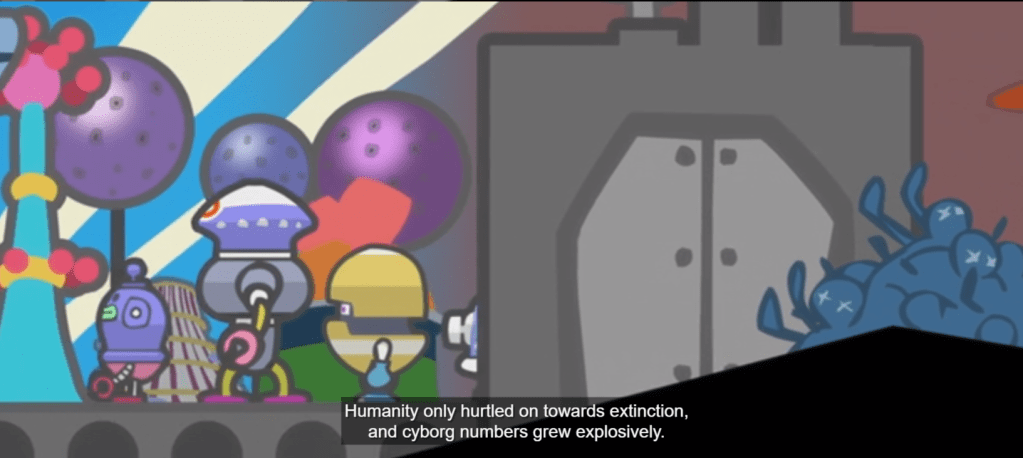
Fisher’s posits that Capitalism is the only form of economic and political governance that we can even imagine because of its all-consuming nature. Deca-Dence then carries this point through, creating a post-apocalyptic universe where corporations have quite literally consumed the entire planet, rendering it inhabitable for humans and giving way to cyborgs. Capitalism is simply an economic system based on private ownership of the means of production and their operation for profit (thanks Wikipedia). And to me, the central tenant of this global economic system after World War II has been the constant need for growth, driven, of course, by increased consumption. You can see it quite clearly in the way the Federal Reserve, the central public banking system in the US, sets their criteria for implementing monetary policy: a target of 2% inflation every year (they now target symmetric 2% inflation, but it’s not worth getting into that nuance). The most distinguished economists in the US are basically all in consensus that a society is healthy if price levels are growing by 2% every year, which, you guessed it, only happens if demand is increasing. In a system governed by supply and demand, where you keep trying to constantly increase demand all the time, the supply will eventually run out… And in the 2400’s, that’s exactly what happens in Deca-Dence’s universe.
“Capital’s ‘need of a constantly expanding market’, its ‘growth fetish’, mean that capitalism is by its very nature opposed to any notion of sustainability.” – Fisher (19)
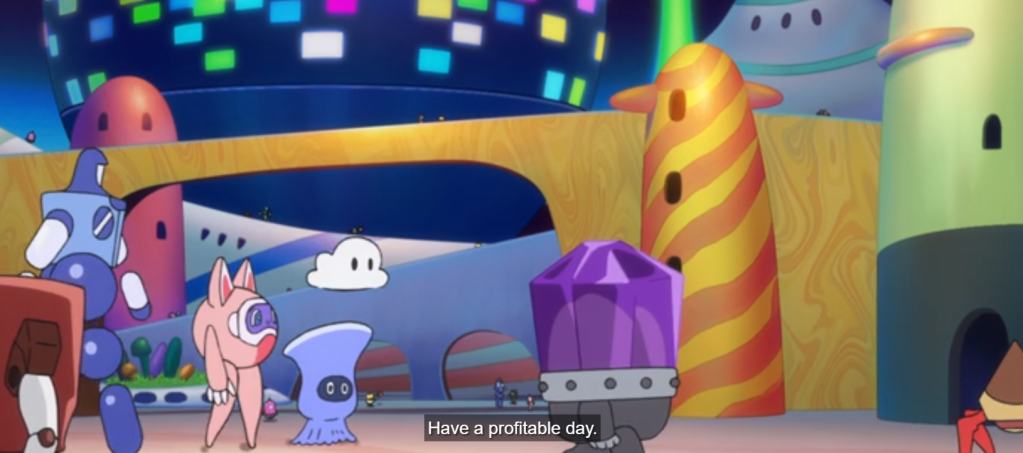

Tachikawa’s decision to use simplistic, Astro-Boy like character designs for the cyborgs and traditional, semi-realistic designs for the humans was his boldest choice for the show. The cyborgs, which are all property of the Solid Quake corporation, are represented by wacky shapes and vibrant colors, while the humans live in a world with nothing but inevitable death. Corporations, fueled by the incessant need for growth, sucked the planet dry and then simply moved on to create a sterilized world for themselves. It wouldn’t be a stretch to say that you don’t need to look all the way to 2400 for that world. We’re living in it right now. Climate change, driven largely by American and European companies, has created disproportionate wealth for some and at the very same time has led to wildly disastrous pollution and climate externalities for mostly brown and black people. And, of course, in Deca-Dence, climate change and air pollution are what create an uninhabitable world. It’s only fitting that Fisher compared Capitalism to an abstract parasite, insatiable vampire and zombie-maker. It eats everything in its path until there is nothing left. In Deca-Dence, the human soldiers are forced to live in a crammed storage facility and morn the dead after their battles with the Gadoli monsters, while the Solid Quake corporation, who manufacture these monsters for profit and amusement’s sake, happily tells its cyborg citizens to “have a profitable day.”
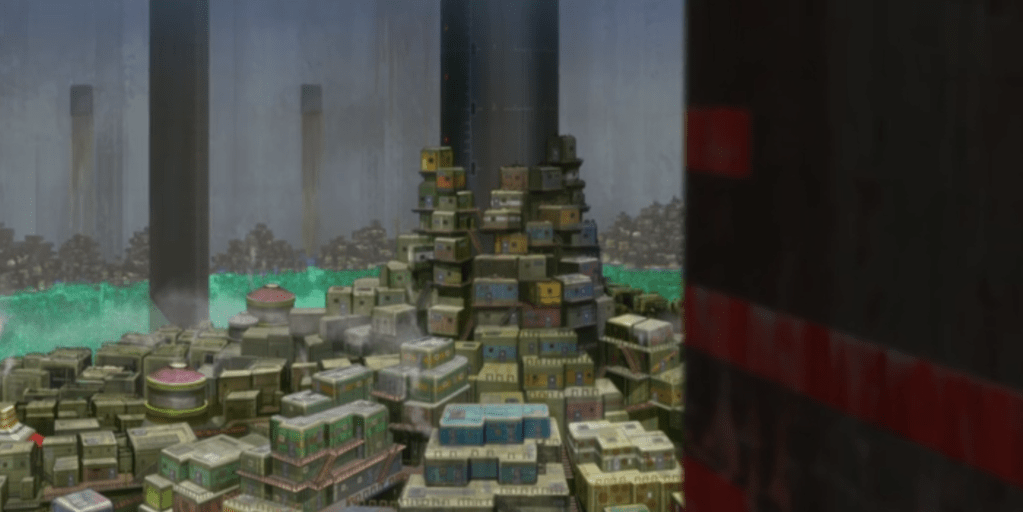
Tachikawa’s inventive concept art for the show plainly illustrates the consequences of a world with nothing left to offer.
The Big Bad Villain
“At the level of the political unconscious, it is impossible to accept that there are no overall controllers, that the closet thing we have to ruling powers now are nebulous, unaccountable interests exercising corporate irresponsibility.” – Fisher (63)

Near of the end of his book, Fisher makes the point that Capitalism creates an environment where it is impossible to actually put blame on any single person. The decentralized, commodified nature of Capitalism makes it so that no one person or organization is actually responsible for the problems that it creates. And this is the tricky thing. It’s easier to call for change and knock down the existing system when you can point to a single bad actor. Fisher uses the example of climate change to drive this point home.
“Instead of saying that everyone is responsible for climate change, we all have to do our bit, it would be better to say that no-one is, and that’s the very problem. The cause of eco-catastrophe is an impersonal structure.” – Fisher (66)
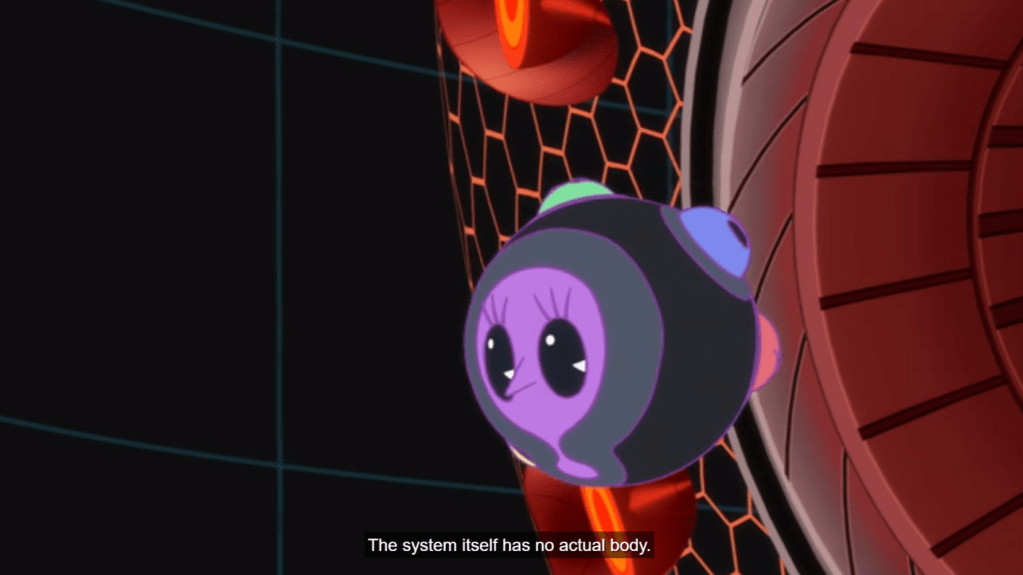
Most people watching Deca-Dence were waiting for that moment when the big villain would finally appear. It’s that part in the movie that people always crave for; when the onion finally gets peeled back and the face of the real face of the enemy is revealed. With the Solid Quake corporation, it was easy to imagine some badly-lit board room, where shadowy figures were pulling the strings behind the entire game operation. However, when Kaburagi finally confronts Hugin and Mugin, the
game police Deca-Dence, they reveal that the all-powerful system actually has no physical representation. It is simply a system originally made by the collective will of the people, going through periodic updates. For some, this lack of a reveal was disappointing, but I think it ultimately lends itself to Fisher’s point. It’s scarier that there isn’t some bad guy that Kaburagi can just punch out to save the day.
There is an Alternative
“The very oppressive pervasiveness of capitalist realism means that even glimmers of alternative political and economic possibilities can have a disproportionately great effect. The tiniest event can tear a hole in the grey curtain of reaction which has marked the horizons of possibility under capitalist realism. From a situation in which nothing can happen suddenly anything is possible again.” – Fisher (81)
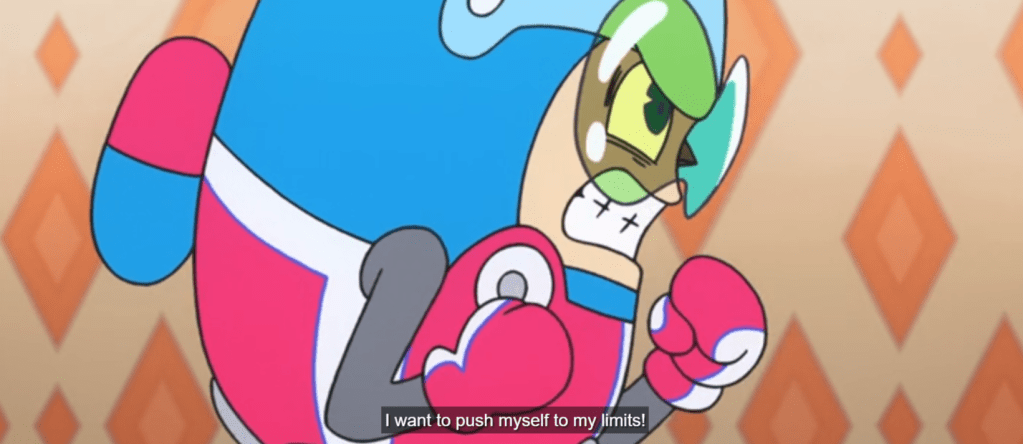
Fisher ends his book on a note of optimism, saying that any hole, no matter how small, that pokes through the blanket of Capitalism can open up a world of possibilities. If the thing that makes Capitalism so powerful is its ability to block out any other alternatives, then the mere glimmer of another choice can crack the foundation of the whole system. In Deca-Dence, this is exactly what drives the central narrative of the show. Kaburagi, having given up on life, is assigned to work with Natsume, the shows other protagonist, on ship repairs. Despite only having one arm and being considered a “bug,” Natsume wants to fight the Gadoli and push her limits. Her actions remind Kaburagi of a former ranking teammate, Mikey, and show him that there is something beyond the reach of the system. Having been labeled dead many years earlier, Natsume is quite literally not within the scope of the Solid Quake corporation. She is that glimmer and gives him a reason to live on: tearing down the system that has oppressed and controlled both humans and cyborgs.
However, Deca-Dence‘s actual story is somewhat hampered because Natsume seems to only function for this purpose. By the sixth episode, the show seems to lose interest in developing her any further, and she functions only as inspiration for Kaburagi in the second half. While Natsume’s journey serves to illustrate the resilient nature of humanity, she doesn’t get much screen time or even choices to make once Kaburagi is sent to the underground prison. Given the cast isn’t that large or memorable, having two strong leads was needed to carry this show, and I can’t help feeling that solely focusing on Kaburagi was a mistake.

Wrapping Up
While Deca-Dence and Capitalist Realism are two very different pieces of media, they both do an incredibly good job at shedding light on the problems of Capitalism. Whether or not you think Capitalism is a net good or bad economic system, there is no denying that it’s tough at this point to imagine a world without it. It’s easier to imagine our planet eventually burning itself down. Capitalist Realism spells out the problems existing right now, while Deca-Dence shows us what the future may look like. Tachikawa’s anime does have some narrative short-comings, but it is certainly one of the more thoughtful shows to come out in a while. Capitalist Realism will likely not make me suddenly renounce my current way of living, but it did push many of my prior ideas on just how harmful our current economic system is. If you haven’t taken a look at either, I’d highly recommend you pick up both. The book is pretty cheap on Amazon, and you can buy a Hulu account to watch Deca-Dence (yes irony was intended there).

 Coc0na's Pure Illusion