
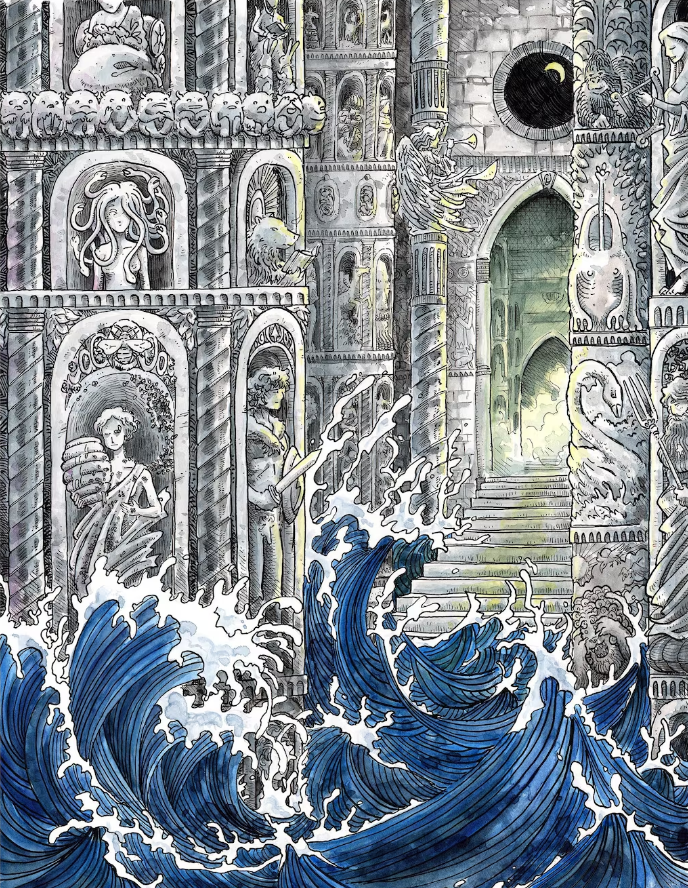
Piranesi is the first book I read to start this year. It’s a fascinating story, and I’m going to break up my post into two parts: (1) a non spoiler review and (2) a few journal entrees that try to imitate the style of the book from my perspective.
Piranesi is a fantasy novel written by Susanna Clarke. The book is told from the first person perspective of Piranesi, our main character, through journal entrees he writes every day. Piranesi lives a place called the House, which is a world filled with infinite halls and statues. Each statue is unique. There is a statue of a woman with a beehive and another depicting an elephant carrying a castle. The lower level of the House has an ocean, which the upper level is filled will clouds. The only animals in the House are fish and birds. Our main character spends his time tracking all the details of the House in his journal. This is the only world he’s every known. But, Piranesi is not afraid.
Every other week, he meets with a person called the Other, who has asked Pirenesi to help him search for a great secret knowledge hidden in the House. As the novel progresses, we quickly learn the House and the Other are not who they first appear to be.
I love this book because of the way Piranesi approaches the House. He does it with such joy and wonder. Piranesi’s journal entrees make the House seem impossibly beautiful. It’s a reminder that while the world we live in is also amazing and full of life, you can only appreciate it if you try to sit down and observe it.
Lately, I’ve been thinking a lot about the concept of impermanence. In Buddhism, this doctrine asserts that all of existence is transient. All things, whether material or mental, will even fade and turn to dust. While this concept can seem scary and brutal, I think there’s real beauty in it. If we accept the ephemeral nature of existence (god, that sounded so pretentious), it’s easier to stop trying to look for the next best thing that will make us happy. Instead, we can just sit down and observe the beautiful world around us right now.
In that spirit, here are a few journal entrees from my life in the style of Piranesi.
A description of the World
ENTRY FOR THE SIXTEENTH DAY OF THE FIRST MONTH IN THE YEAR THE CAT AND I MOVED HOMES
I am determined to explore as much of New York as I can in my lifetime. To this end, I have travelled as far as the infinite field of flora and fauna 14 miles north (1). I have climbed up to the upper floors where the sunset casts a red horizontal beam across the city (2). I have explored the island where music plays day and night (3). I have been to the labyrinth where the entire history of the world has been documented (4).
In all of these places I have been, I have never seen any indication that the landscape of New York City was coming to an End, but only the regular progression of buildings and concrete into the Far Distance. As an observer of this city, I have made it my job to document everything that I see, touch, smell and hear.
I start my journey this morning by traversing into an underground hall. This hall represents the 35th point of transportation of the orange vehicle moving north (5). There is a daily toll I must pay to get across and use the transportation.
Notes:
(1) New York Botanical Garden.
(2) 30 Rockefeller Plaza, 54th Floor. My old office. Great view of the city in the evening.
(3) Randall’s Island / Ezoo. What a shit show this year, but honestly was still pretty fun.
(4) Museum of Natural History. I actually have a membership there. Fun fact.
(5) F train 23rd Street Stop.
Rooftop Water Towers
ENTRY FOR THE SEVENTEENTH DAY OF THE FIRST MONTH IN THE YEAR THE CAT AND I MOVED HOMES
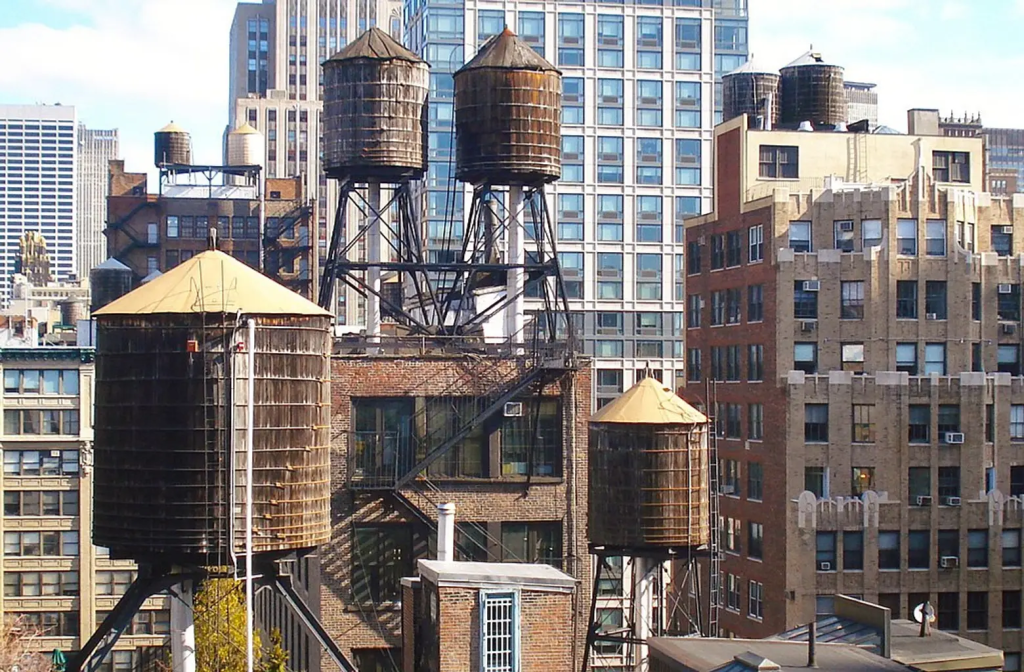
As I sit in my Living Room, with all of my bags packed for the Long Journey I am about to make (1), I look towards the Northwest Windows in my Living Room. Through the Windows, I can see and count as many as six Water Towers that sit above buildings (2).
While the rough shape and dimension of each Water Tower is the same, every other quality of these six specific Water Towers is different. The Barrels are made of wood, or, at least, they appear to be, and each Water Tower’s wooden Barrel is discolored to a different degree. The Water Tower closest to me is a bright oak color. The Water Tower behind the one closest to me is also an oak color, but roughly a third of the barrel’s wood has been discolored into a dark grey. For these dark grey Barrels, I wonder, did they start out in the bright oak color, or were they always this dark? If they started out as a lighter color, how long did it take for them to discolor?
As I continue to stare out of this Window, I am realizing something and need to apologize to anyone reading this journal, as I have misled you. There are in fact five more directly to my right and four more in the Northwest corner! It is both exciting and overwhelming to realize how many Water Towers surround me. I think I can be forgiven for missing one of the Water Towers in the Northwest corner. Half of this Water Tower is cut off by a building in front of it. It reminds me of a Cat peaking through the corner of a door.
I am noticing that each Water Tower either has a wooden or metal cone shaped roof. To be specific, only three of the 15 Water Towers I see have metal roofs. They look to be aluminum (3). I am unsure why some Water Tower Creators opted for a wooden or metal roof. The Barrels of each Water Tower are lined with a series of thin metal tubes that wrap around the Barrel. Interestingly, on most of the Water Towers I can see, the thin metal tubes are bunched up at the bottom of the Barrels and the distance between each tube gradually increases as you reach the top of the Barrel.
Each Water Tower I can see also appears to sit on an elevated surface. None of them appear to sit directly on the roof of the building. The elevated surfaces, in every water tower I can see, are composed of a black metal structure with a ladder attached to it.
To break the fourth wall here, I have now become legitimately very interested in the history of water towers. I’ve included some fun facts I learned after researching in the notes (4).
Notes:
(1) I’m about to move apartments.
(2) The picture above isn’t mine. I just grabbed it for an easy visualizer.
(3) I later understand that these are steel.
(4) NYC Water Tower Fun Facts:
A. Water Towers were first established in New York in the 1880’s to replace unsanitary well-drawn water.
B. Three family companies in NY construct all the Water Towers – Rosenwach, Isseks Brothers and American Pipe and Tanks.
C. Wood is used because it is cheap, light weight and does a better job moderating water temperature than steel.
D. The wood used for Water Towers eventually rots and needs to be replaced every 30 - 35 years.
E. There are roughly 15,000 Water Towers throughout New York.
The point of the above journal was less about going on an insane rambling on New York water towers (although I think that’s what it ended up becoming). It was more about trying to take a second to observe the world around me. In my almost six years of living in New York, I don’t think I’ve ever thought about or even consciously seen a water tower here. There is so much nuance, beauty and detail sitting right in front of us, and I want to do a better job trying to appreciate it. If you somehow managed to get this far into the article, (1) thank you for taking the time to read it and (2) let me know of some mundane, every day thing that I should try to pay attention to more.

 Coc0na's Pure Illusion