
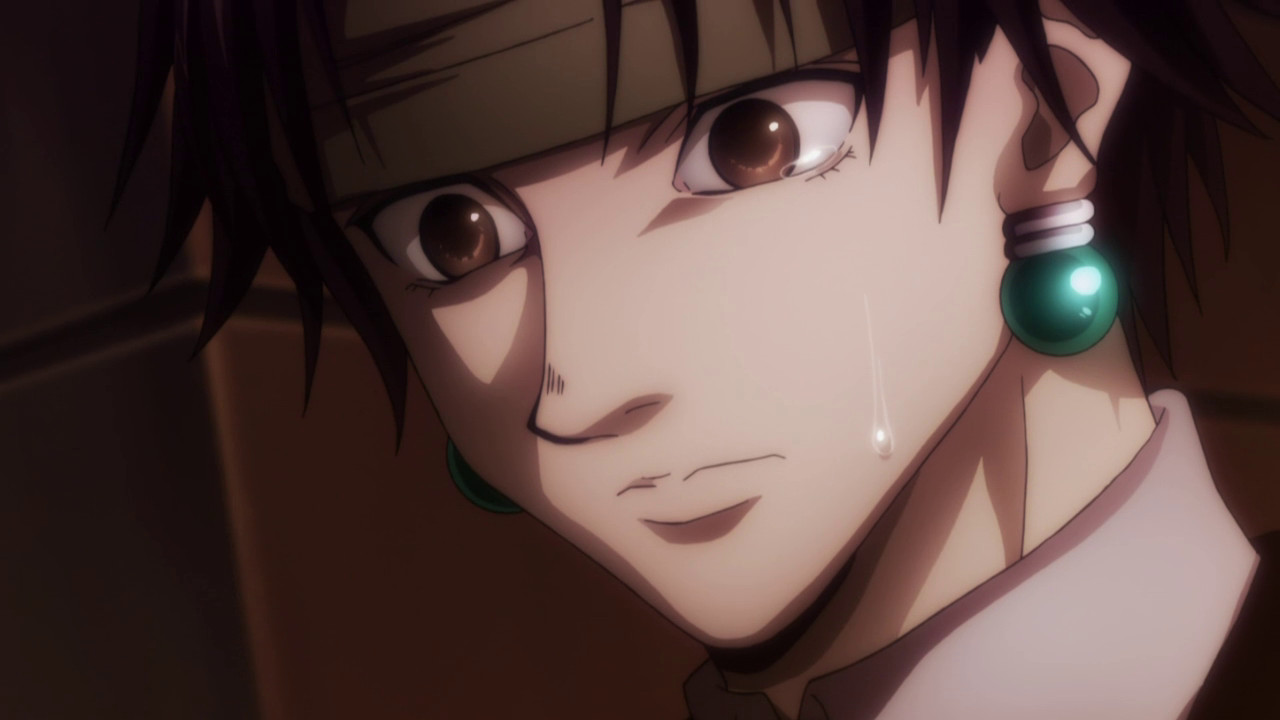
Chrollo Lucifer, the head of the Phantom Troupe, is an enigmatic figure that’s loomed large throughout Hunter x Hunter. On my first read / watch of the series, I thought of him as a villain that was cool, calculating and detached. He didn’t seem to place much value on the lives of others. My initial impression is he believes the value of life, including his own, is worthless.
It’s an odd feeling to get from a character. Almost everyone places a high value on human life. One of the constant struggles of living is trying create some sort of proof that our life was worth living. Trying to make a lot of money, become famous, get social media likes… create blog posts. A Proof of our Humanity. But Chrollo sees things differently, at first glance.
The head of the troupe seems believes there is no Proof of Humanity. To him, life is worthless. He’s led the Phantom Troupe to massacre scores of people for seemingly no reason. This is something that Gon, the protagonist of Hunter x Hunter, can’t understand. In his only interaction with Chrollo throughout the entire series, he asks one question to him. And it’s a pointed one.

As the story progresses, we learn more about Chrollo, and the answer becomes clear. To start to answer Gon’s question, let’s shift to Hunter x Hunter Volume 34, which begins in an unexpected way. It opens with a fight between Chrollo and Hisoka in Heaven’s Arena. Chrollo begins in typical Shounen fashion, explaining how his ability works. He tells Hisoka about the powers he’s accumulated since the Nen exorcist freed him from Kurapika’s Judgement Chain, which had prevented him from using Nen.

To briefly re-explain Chrollo’s ability, Bandit’s Secret allows him to steal other’s Nen ability if certain conditions are met. One of his stolen abilities is called Order Stamp: Proof of Humanity.
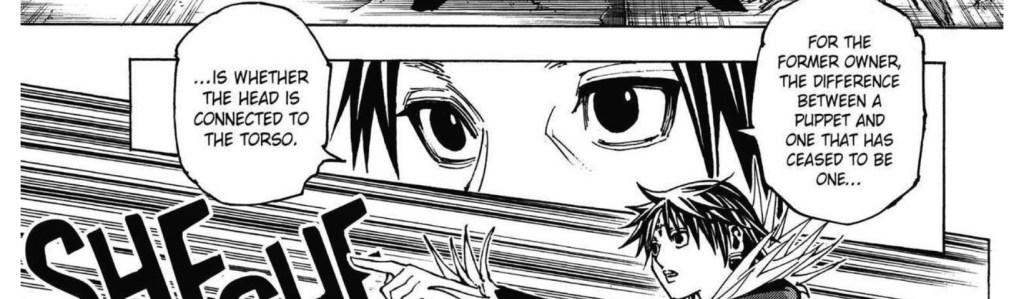

It’s an interesting ability. Less because of the actual function, which is fairly straightforward – a puppet with the stamp can be controlled to do certain, basic actions. More because of the interpretation of what makes something a puppet. To Chrollo, there is no difference between a dead person and a puppet. To the former owner of the ability, there was a difference. Chrollo’s explanation suggests he holds little regard for the dead or the living.

Most people are driven by some desire to feel like their life, or their humanity, was meaningful.
But for Chrollo, there’s no difference between a dead person and a puppet. He believes there is no difference between a dead person, living person or dead person without a head. They’re all objects to be controlled and slaughtered.

Chrollo doesn’t relate to other human’s need for the proof of existence. He finds them interesting.
Why do some people need to prove their existence? When you leave the Earth, you’re gone. There’s nothing left of you – besides the memory of you that lives with others. That’s scary, so most people want some proof of your existence beyond that. Otherwise, when you die, there’s nothing left.

But for Chrollo, he’s already accepted death. That becomes a primary plot point in Yorknew City. Kurapika kidnapped him to bargain with the Spiders to get Gon and Killua back. Kurapika threatens to kill him, but Chrollo isn’t scared. He’s accepted death. This makes sense when you realize he views humans as interchangeable from corpses and puppets.
This could be characterized as simply lacking empathy. And if that was all there was to Chrollo’s character, he wouldn’t be all that interesting.
Gon, the character I’ve always loved the most in the series, is perplexed at how Chrollo could kill and not feel any sort of way about it. However, when he presses Chrollo on why he kills people, the villain gives an interesting response.
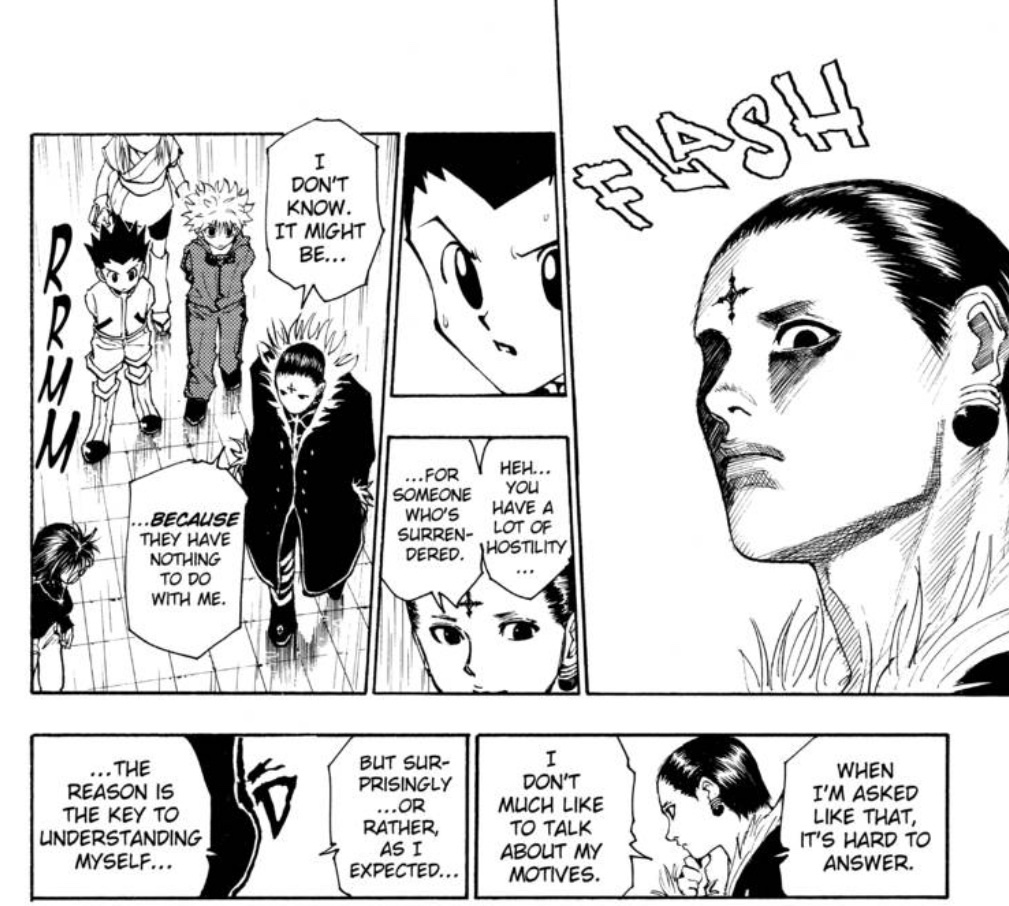
Chrollo gives, at first, the throwaway answer we would’ve expected. Those people aren’t related to me, so why does it matter if they die? But he goes on, and seemingly starts to question himself. He doesn’t like to talk about why he does it.
However, Chrollo finally answers this questionwhen Kortopi and Shalnark are killed by Hisoka much later in the series. The below panel shows us how much the death of his comrades means to him.

On the ship going to the Dark Continent, Chrollo sits on the fifth tier, having a conversation with another passenger. The bold line strokes from Togashi make Hisoka’s mental state clear. He’s furious about the death of his two Kortopi and Shalnark.
“Ties are to be Severed… Not Forgotten.” Earlier, I mentioned that when we die, what remains is how others remember us. The memories are not to be “forgotten.” In fact, memories become even more powerful after death, which is fitting in a series where Nen becomes stronger after death. This universal fact even applies to Chrollo. As we learn in a flashback featuring the Phantom Troupe, the powerful memories related to a death of one of his friends is what turned him into this ice cold villain. The act he puts on of not caring for others is simply a farce to keep danger away from the ones he holds most dear.
The Phantom Troupe was originally an acting troupe formed in Meteor City. In the flashback, we see that their friend Sarisa was brutally murdered by an unknown group, with her remains sent back in a bag and hung on a tree for Chrollo to find.
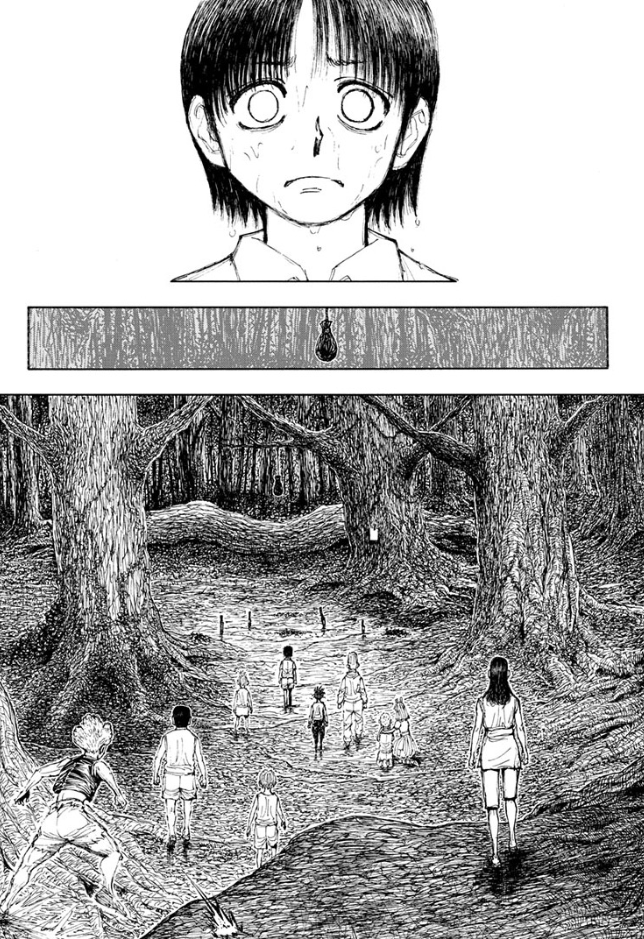
I love the composition of the page above. We start with Chrollo’s reaction, which is placed on a blank panel, highlighting the horror in his face. Then, the next panel is a bag, presumably holding the remains of his friend, Sarisa. The transition from the first panel to the second makes clear what he’s focused on and the impact it’s having on him.
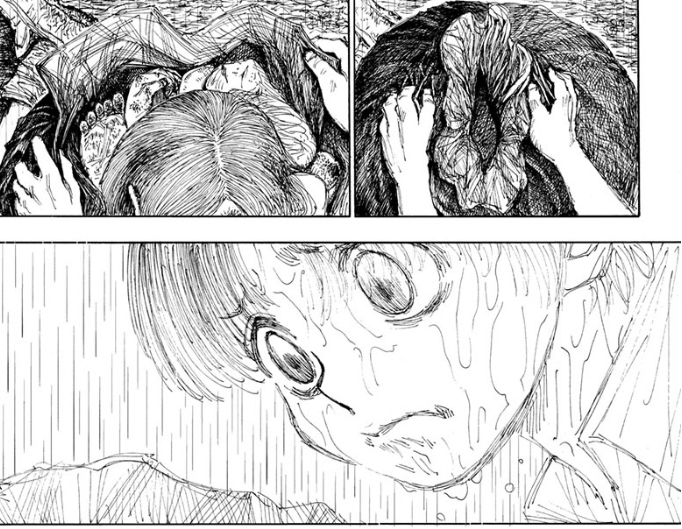
Togashi continues to show his mastery of the art form with the panels above. He leans into heavily detailed images with the first two panels, highlighting the gruesome nature of the dismembered body parts. Then, he transitions to Chrollo, where the sketched lines of his face show how terrible this scene is for him to witness.
Without using a single word, Togashi illustrates how much of an impact Sarisa’s death had on him. The tie has been severed, but as we see in the below panel, which wraps up the flashback… it has not been forgotten.

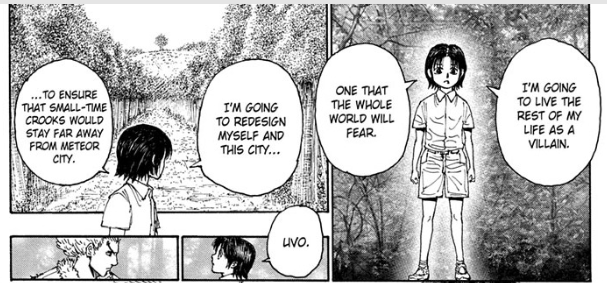
After finding the remains of Sarisa, Chrollo resolves to become a villain. Fittingly, as a member of a troupe, he puts on the act of someone that doesn’t care about the value of life. That’s the Chrollo we see at the start of the series in Yorknew City.
He wants to create a state of fear around him, so people won’t harm the citizens of Meteor City. It’s ironic. He’s put on a mask of complete apathy for life because he cares so much about the lives of those closest to him. And isn’t that a very human thing to do? We all place so much value on the lives of those closest to us. It then becomes easy to prioritize our loved ones over others. Chrollo does it to such an extreme, becoming a villain for the series.
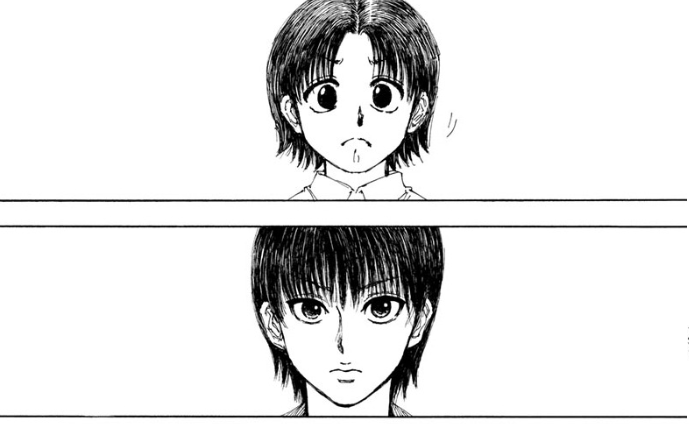
But it’s all a matter of circumstance, right? The small, unsure and unassuming boy in the panel below is slowly transformed into an unsmiling, calm villain because of horrors he was forced to witness. It his memory of Sarisa and her death that’s led him to the cold life he currently lives.
Unlike some of my other essays, this one unfortunately points to the idea that sometimes the cycle of hatred and violence is hard to break. The meaning that we put on the lives of others. On the way they lived. On the way they died. It sticks with us. And sometimes, it leads to people becoming the very thing that hurt them in the first place. It’s our Proof of Humanity.

 Coc0na's Pure Illusion