

Year 2!
Tier One: A Masterpiece (9.5 – 10 / 10)
1. Jonathan Strange and Mr. Norrell (Book)
After I finished Susanna Clarke’s more recent novel, Piranesi, I decided to read another one of her books. Enter Jonathan Strange and Mr. Norrell, my favorite book of all-time.
It’s an alternative history set during the Napoleonic Wars. Magic used to exist in England, and the book revolves around two men, Jonathan Strange and Mr. Norrell, who have brought this force back into the world.
The novel reads like Anna Karenina meets Harry Potter. It has flowery language that reminds me of Tolstoy. Like Harry Potter, it has magic, but the magic is dark and weird. For example, when Strange goes to the Iberian Peninsula to help the Duke of Wellington in his military campaign (sorry, that was a mouthful), he resurrects dead Spanish soldiers to learn the current whereabouts of the enemy. The undead soldiers give Norrell and the English the information they sought, but Norrell is unable to put down the soldiers. The undead soldiers end up following around the English troupe, begging not to go back to Hell. Strange and the English then have to burn them to ashes (dark, yeah).
My favorite part of the story is Clarke scatters over 200 footnote throughout the book. Each footnote is like a short story unto itself, giving meticulous color to her entirely invented history of magic.
Weird magic and detailed footnotes are great, but what makes the book amazing is the cast of characters. The book is called Jonathan Strange and Mr. Norrell for a reason. It’s about their friendship and shared passion. Jonathan Strange is a charismatic lead that steals the spotlight the minute he’s introduced, while Mr. Norrell is a timid, scholar-type. There’s the chilling villain, a fairy called The Gentleman with the Thistledown Hair. Clarke does a great job writing him. The Gentleman is at once incredibly powerful, otherworldly and freaking hilarious.
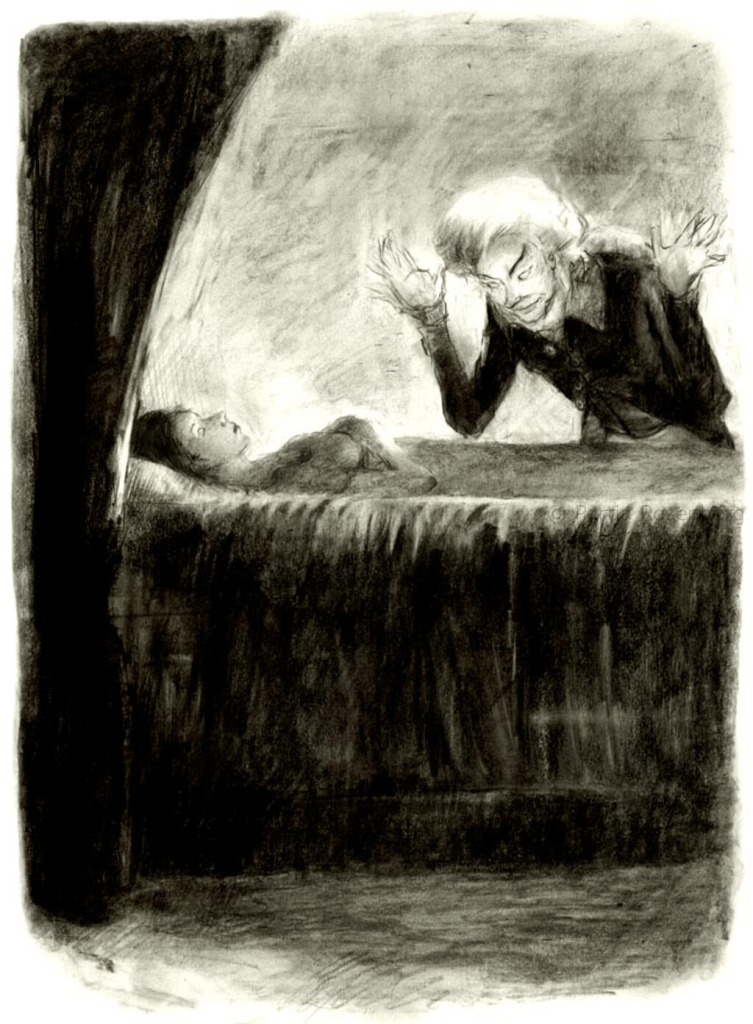
The Gentleman’s intent on making Stephen Black, the butler, a grand king, which Stephen has absolutely no desire for, had me laughing out loud throughout the book.
John Childermass, Mr. Norrell’s servant, and Vinculus, the vagabond street magician, both bring a needed element of griminess to the story. They give color the darker underbelly of society, which serves as a really nice contrast against the more gentry-like characters that dominate the novel. There’s an absolutely great passage where Childermass and Vinculus are in the backroom of a tavern in the dead of night, playing a Tarot card game and discussing the future of magic in English society.
This book is definitely not for everyone, but I absolutely loved it. There’s nothing I would change about this story.
2. Minnesota Timberwolves vs. Denver Nuggets Western Conference Semifinals – Game 7 (Sports)
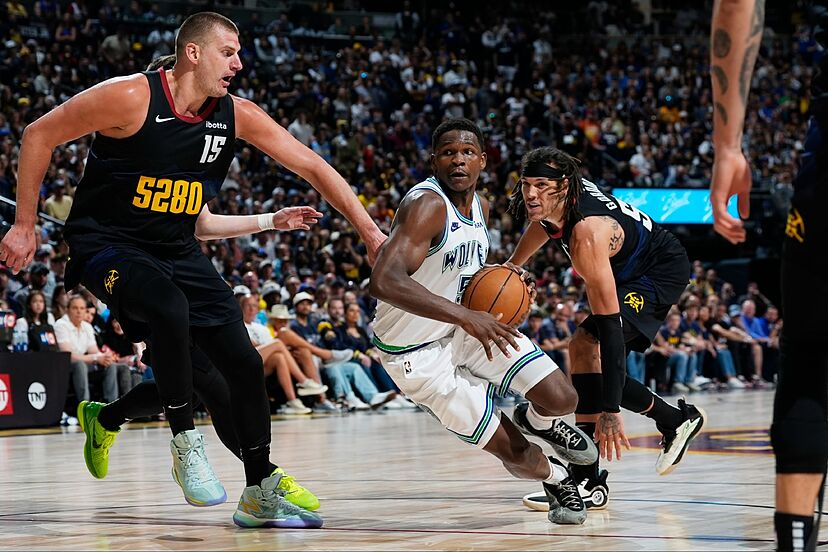
What does it mean to be a fan? It’s 2013. You’re in high school. There’s a big test to study for, but you’re too distracted watching the middle-of-the-road Timberwolves play a middle-of-the-road opponent in the middle of the season. You’re getting increasingly frustrated as Shabazz Muhammad keeps on driving to the rim and fails to make the obvious pass. They lose. Shit. You’ve just wasted 2 and a half hours pulling your hair out for a team that’s going nowhere this year. They also went nowhere last year. And the year before. And the year before that. Being a fan can sometimes suck.
Now let’s fast forward a decade. 2023 – 2024 Minnesota Timberwolves. The team didn’t come in to the season with sky-high expectations. Last season, they never properly integrated Rudy Gobert into their team and lost in the first round of the playoffs to the Denver Nuggets. I did not expect the team to go 56-26, finish 3rd in the Western Conference and have the best defense in the league. It was also fun to watch the regular season with my roommate, Tiernan. After coming home from office, we’d sit on the couch, multi-tasking on our work laptops and watch the team dominate the league.
Then came the playoffs. It was a bloodbath between the top four teams in the Western Conference – Thunder, Mavericks, Timberwolves and Nuggets. We swept the Suns in the first round of the playoffs, witnessing Anthony Edwards stunt on Kevin Durant and blossom into a superstar. It was fun, but the real challenge was the team waiting on the other side of the first round – the defending champions, Nikola Jokic, the best player in the world, and his Denver Nuggets.
NBA basketball doesn’t have many rivalries in the modern age. There’s too much player movement. but if there has been a real rivalry to watch in the league, it’s been the Minnesota Timberwolves and the Denver Nuggets. The Timberwolves roster was constructed for the purpose of countering Jokic, the league MVP. The Timberwolves near-perfected a strategy of putting Karl Anthony Towns on Jokic, while keeping Gobert as a spy hanging under the rim, while he cheats off Aaron Gordon. What do you do when Towns gets tired? Sub him out and put in the sixth man of the year, Naz Reid. Jokic dealt with a hydra of these three big men every minute he was on the court.
The Western Conference Semi-finals match up between the two teams was anticipated to be one for the ages, and it ended up being just that. Each game featured micro-adjustment upon micro-adjustment from each team.
Nuggets Counter (Game 3 – 5): Less Jamal Murray bringing the ball up. More Aaron Gordon initiating offense to save Murray from getting full-court pressured and also punish Gobert for cheating off Gordon in the paint
Timberwolves Counter to the Counter (Game 6 – 7): Sag off Jokic when he’s at the three point line and dare him to shoot. Pack the paint because Jokic does more damage there. Utilize Gobert more on the offensive side as a screener and roller
By the time we hit game seven, there was no adjustment left to be made. The Timberwolves defense was good in the first half, but it didn’t matter. The Nuggets had a 15-point lead at halftime. Okay, not great, but there’s a whole second half to play. Shit. It’s five minutes into the third quarter and the Nuggets are up by 20. Well, we’re playing in Denver. It’s been a good season. Pack your bags. We took the defending champions to game seven. We can hold our head up high. We’ll get them next year.
But then something funny happens. The Timberwolves come back. Jaden McDaniels goes nuclear. Towns gets a crazy put-back slam. Did Gobert just use Jokic’s own move against him? Naz drives to the rim. Ant calls for the ball. Corner three. Bang.
Why did we come back? It’s hard to pinpoint a reason, but I think it boils down to the boring answer of the Timberwolves being young and better conditioned than the Nuggets. Gobert, Towns and Reid eventually wore out Jokic, who struggled with his three point shot all game. Edwards, Walker and McDaniels grinded Murray to the bone. The modern NBA game is so fast and demanding, and the moment you slightly let go of the rope, you’ll get eaten alive by the other team.
I also want to mention Towns’ performance during this game. His defense on Jokic and offense in the first-half of the game were critical for the win. Now that Towns has left for the Knicks, I think it’s pretty easy to say this was his best game as a Timberwolf. I’m happy he got this moment. After toiling with this team for a decade in mediocrity, Towns deserved everything from this game.
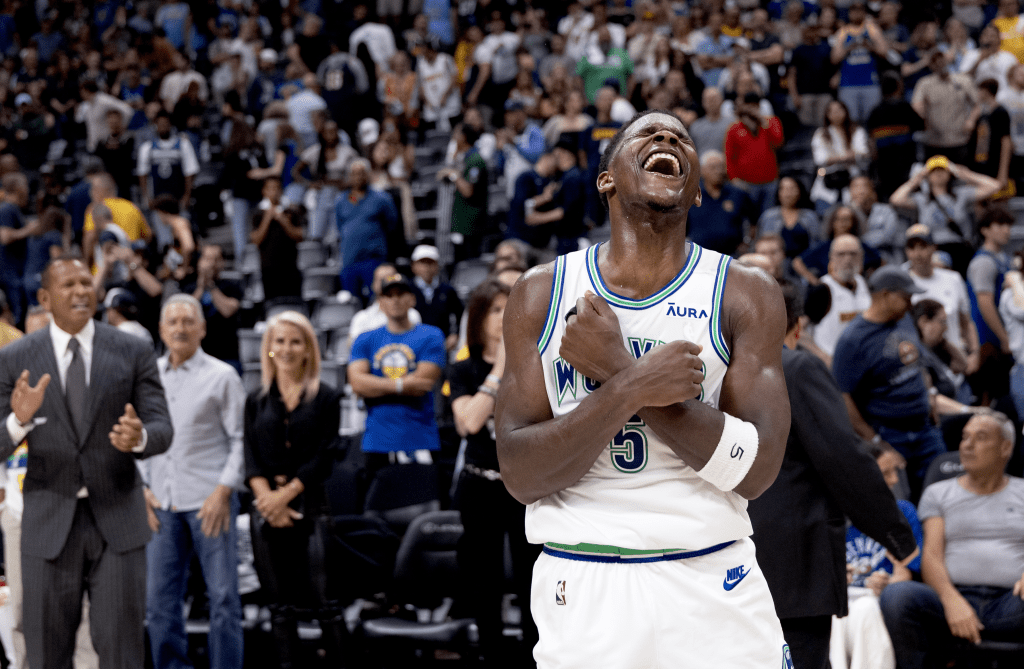
The entire sequence of the third and fourth quarter felt surreal. We were supposed to lose. That’s what always happens. But being a fan can sometimes be awesome.
3. Hunter x Hunter Chapters 401 – 410 (Manga)
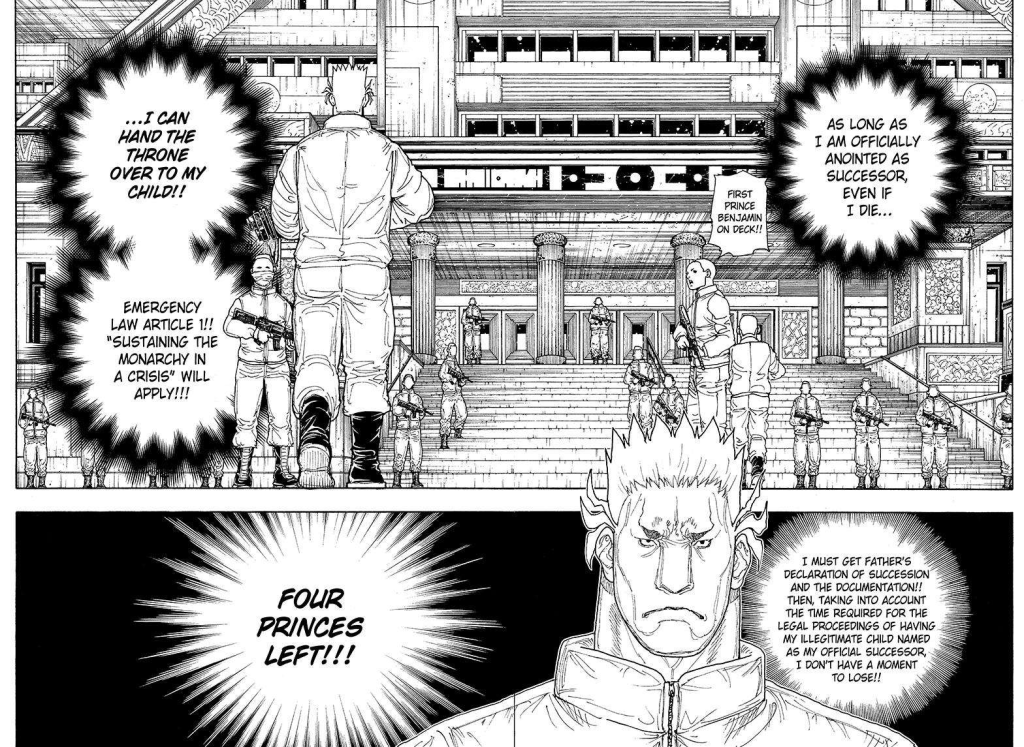
It feels a bit weird to put 10 manga chapters in the middle of a story arc as my third favorite thing of the year, but Yoshihiro Togashi is a genius. The story he’s constructing with the Succession War is the most ambitious thing I’ve seen in the medium. There are so many characters, new and old, that are dancing around each other. You have 14 Kakin princes fighting to the death, aided by Lovecraftian-like Nen beasts. You have Kurapika and his ragtag squad of hunters trying to force a stalemate in this bloody contest, as they look to survive until the massive whale-shaped ship they’re on reaches the new continent. You have the Phantom Troupe, looking to track and kill Hisoka, who’s hidden on Tier-1 of the ship. Then, there are the three Kakin mafia clans, who serve the aforementioned princes and control the underbelly of this ship. And desperately trying to hold the peace, you have the Hunter Association.
There are so many characters and plot points to keep track of, but the reason I’m putting these chapters as my third favorite thing of 2024 is that Togashi has finally started to slowly constrict the intricate web he’s constructed. Chrollo is going to head to Tier-1 and try to steal the Kakin’s royal treasure, where he’ll likely inevitably collide with Kurapika and Hisoka. We were obviously left with a huge cliff hanger at Chapter 410, with 9th Prince Halkenburg successfully poisoning his brother, 1st Prince Benjamin, who’s has nine hours to kill the remaining princes before he dies.
That’s to say nothing of Togashi’s artwork, which remains masterful throughout the 10 chapters. He does such a good job shifting his art style to appropriately convey the mood, as he bounces from panel to panel. For example, look at the first panel below, where Togashi uses scribbled lines and subtle inking to convey Chrollo’s emotions. Now check out the second panel, which is much more simple and conveys the seemingly light-hearted tone Morena is trying to give off.
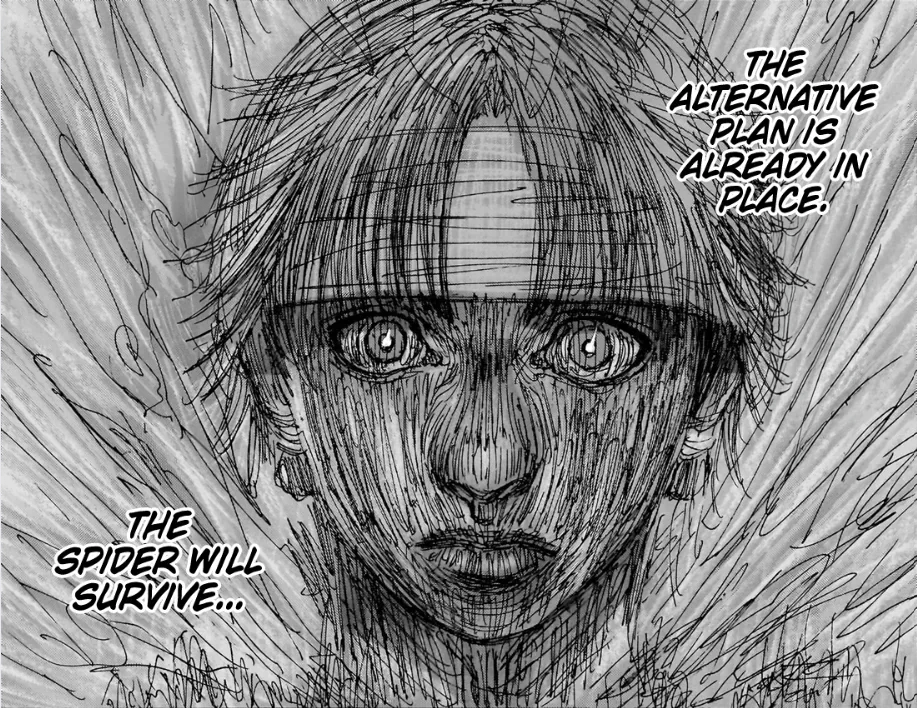
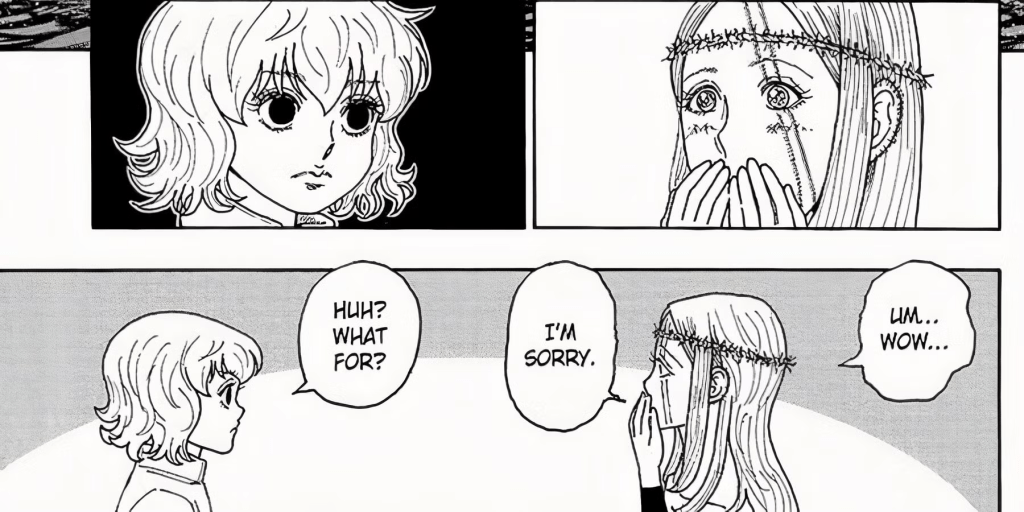
It was so fun reading these chapters live with the broader Hunter x Hunter community. Everyone was excited for this batch of chapters, and it was great seeing people on reddit debate things and youtubers do an amazing job postulating new theories. This string of chapters reminded me of the great aspects of fandom. People excitedly coming together to discuss something they’ve loved for so long. I’m pumped for the next 10 chapters.
4. Good Material (Book)
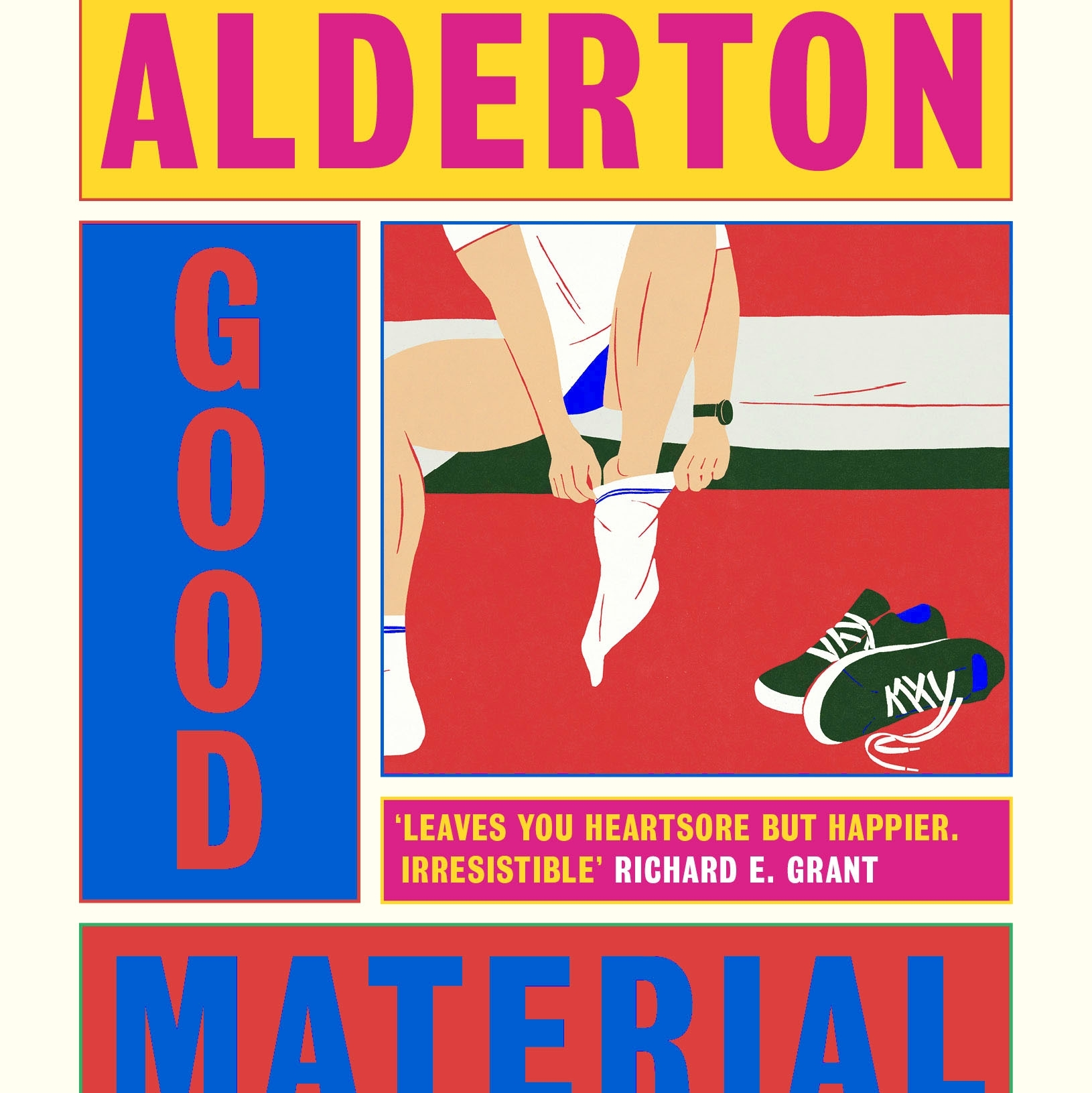
There are books below Good Material on this list that are technically better written and more ambitious. However, I think that Good Material had my heart. It tells the story of Andy, a mediocre, 35-year old comedian going through a break up. He’s heart-broken and feels like his friends don’t understand what he’s going through.
When writing this book, Dolly Alderton interviewed a bunch of men. It was an interesting challenge because this is her first book written from the male perspective, and she wanted to authentically capture the experience of a guy going through a break up. She did a great job, as the kernel of truth she arrives at is basically a lot of men don’t have the language required to properly talk about their emotions with their friends. I think that’s really true, and it was so fun to watch Andy organically come to that conclusion. Your with him and his mates, sitting in a pub, as they try to talk about anything other than Andy’s relationship. In Andy’s head, he’s thinking, how can we not be talking about my tragic break up right now?
The book also does a great job capturing the feeling of trying to maintain old and form new connections in your late 20’s and early 30’s. It’s a period of transition. We have friends we feel like are moving on and leaving us behind. There are new people entering our lives. It’s really confusing.
I also loved Andy’s relationship with his mom. She’s so sweet, and you can tell she her love for him is unconditional. She only wants what’s best for her son, but she also won’t lie to him and say he’s perfect when he isn’t.
My favorite part of the novel is during the last part when the perspective switches, and we get to hear Andy’s ex-girlfriend’s side. It’s such a smart thing to do because ultimately, with relationships and breakups, it takes two to tango. We learn from his ex-girlfriend that Andy is self-absorbed, underachieving and jealous, but what’s so good is that it’s all in-line with what we already learned. It’s definitely a harsher perspective of Andy, but it isn’t one we haven’t seen. Anyways, here’s a line I enjoyed from the book:
“Getting dumped is never really about getting dumped… It’s about every rejection you’ve ever experienced in your entire life. It’s about the kids at school who called you names… And any criticism at work. When someone says they don’t want to be with you, you feel the pain of every single one of those times in life where you felt like you weren’t good enough.” (374)
One more:
“There are so many hidden miniature break-ups within a big break-up.” (64)
5. Trust (Book)
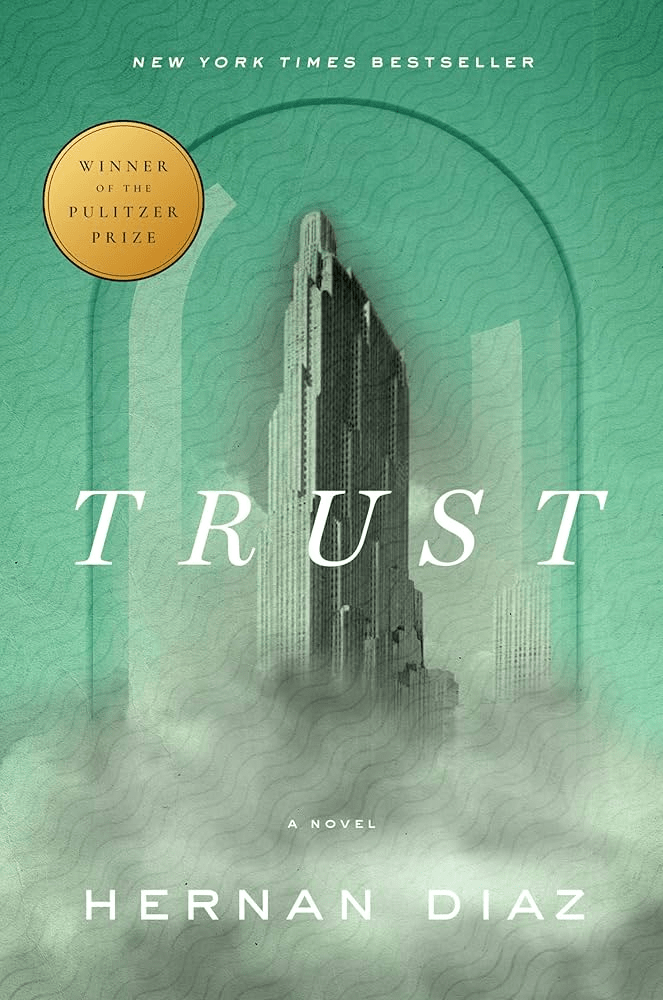
I decided to pick up this book after I finished Demon Copperhead. Trust and Demon Copperhead shared the ’22 Pulitzer Prize, so that plus this book cover (always judge a book by its cover) prompted me to take the plunge.
Trust is actually four books. The first is a fictional novel called Bonds, which tells the life of Benjamin and Helen Rask. Benjamin is a Wall-Street financier who makes an ungodly amount of money during the roaring ’20s and shorts the market right before the Great Depreciation. Helen, his wife, slowly loses her mind after the Great Depreciation. She’s placed in a psych ward, and Benjamin, impatient with her progress, puts her under convulsive therapy, which kills her. The second book is an incomplete autobiography called My Life. It’s written by Andrew Bevel, who’s furious about the novel Bonds, as it’s clearly based on his and his wife Mildred’s life. He’s Benjamin and Mildred is Helen. The third story is called A Memoir, Remembered, which tells the story of Ida Partenza, who, at the age of 23, was enlisted by Bevel to be the ghost writer for his autobiography, My Life. She’s now 70 and recalling that period in her life. The last story is called Futures, which is Mildred Bevel’s diary.
The first two stories, Bonds and My Life, are fine. On their own, they would be near the bottom of my list. However, once you reach A Memoir, Remembered and Futures, you quickly realize that Bonds and My Life are just stories Hernan Diaz, the author, constructed to tear down later in his last two stories. Diaz gets at the heart of story telling by asking the question, who gets to tell the tale?
A Memoir, Remembered was incredibly written. We learn about Ida’s life in Brooklyn with her Italian anarchist father. She is constantly dealing with men, whether it’s her father, boyfriend or Bevel himself, that are constantly putting her down.
“My father exerted an emotional monopoly. His happiness tolerated no dissent. When he was in a good mood, everyone was supposed to be delighted to hear his long stories, laugh at his jokes and cheerfully partake in whatever project he had in mind—calamitous home renovations, around-the-clock printing jobs, excursions to the Bronx in search of an Italian butcher someone had mentioned. But whenever he was low or had been wronged, he made everyone pay for it.”
One of my favorite scenes is when Ida first enters Andrew Bevel’s high-rise, corner office in Wall Street. Her description of the room and the harsh lines that rise and fold into each other is great. Through her experience as his ghost writer, Ida keenly observes Bevel’s true character. In her memoir, she includes the line below from Bevel which, in my mind, summarizes Diaz’s view on storytelling:
“My job is about being right. Always. If I’m ever wrong, I must make use of all my means and resources to bend and align reality according to my mistake so that it ceases to be a mistake.”
Mildred’s story, a smattering of diary entrees as she is slowly dying from cancer, is amazing. This semi-lucid account of her life makes the reader question everything we learned during the first three stories.
“Second, my cancer diagnosis according to which I’d be dead not too long after that. PM. Priest came with soggy offerings of comfort. God is the most uninteresting answer to the most interesting questions”
6. Never Let Me Go (Book)

I think Kazuo Ishiguro’s Never Let Me Go is a perfect book. I saw Issy was reading it, and the premise looked interesting, so I figured it would be worth giving a try. She described it as quietly devastating, and I think it’s a perfect way to sum up this book. It’s quiet in the sense that it feels like Ishiguro wastes no word in this story. Every character, interaction and moment feels needed.
I won’t talk about the plot because I think it’s worth going into this one blind. The first few pages were confusing, but once you get past that section, it becomes a page-turner. The main characters, Kathy, Tommy and Ruth, feel so human. Every moment these characters share together feels like something taken from my own mind. These are people I’ve seen in middle school and high school. They’re myself. Ruth’s insecurities feel like my own. Kathy’s later realizations in life feel incredibly similar to things I’ve come to terms with in my 20’s.
Anyways, I think the below is my favorite thing I’ve read all year:
“I keep thinking about this river somewhere, with the water moving really fast. And these two people in the water, trying to hold onto each other, holding on as hard as they can, but in the end it’s just too much. The current’s too strong. They’ve got to let go, drift apart. That’s how it is with us. It’s a shame, Kath, because we’ve loved each other all our lives. But in the end, we can’t stay together forever.”
7. Demon Copperhead (Book)
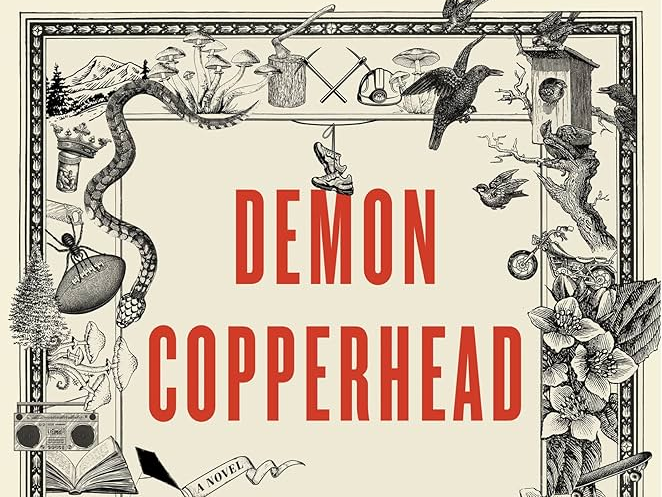
Besides Jonathan Strange and Mr. Norrell, this was the most ambitious book I read this year. Barbara Kingsolver tells the story of ’90s and ’00s Appalachia. It’s a bildungsroman, a tale about Damon Fields, also known as Demon Copperhead, who deals with child abuse, poverty, the foster system and the opioid crisis. Kingsolver uses the structure of Charles Dicken’s David Copperfield to tell the story of her people. We’ve all heard the statistics of the Opioid epidemic, but Kingsolver gives that story the humanity it deserves.
“Live long enough, and all things you ever loved can turn around to scorch you blind. The wonder is that you could start life with nothing, end with nothing, and lose so much in between.” (468)
The characters are great in this book, but I think Kingsolver created some of the most memorable scenes I’ve read this year. Demon and his mom dancing outside their trailer home without a care in the world. Demon holding Emmy’s hand at the aquarium. Demon and his disabled uncle flying a kite outside of their home was one of the most beautiful things I’ve read all year. His uncle writes passages from books on kites and then flies them in the air.
“He was quiet, holding that string and kite with everything he had. The way he looked. Eyes raised up, body tethered by one long thread to the big stormy sky, the whole of him up there with his words, talking to whoever was listening. I’ve not seen a sight to match it. The man was a giant.” (210)
The climax of the novel, where Demon, Hammer Kelly and Maggot confront Fast Forward, the villain of the story, at Devil’s Bathtub was cinematic and intense. Kingsolver sets the mood perfectly with the heavy rain. You know something is going to go down after what Fast Forward did to Emmy (something so unspeakable I don’t even want to write about it here). It’s a page turner if I’ve ever seen one.
Despite the sadness and brutality Demon and his loved ones face in the story, they always move forward. The book can be a bit of a downer, but it’s also incredibly hopeful. You feel Kingsolver’s anger at what outsiders, like coal and pharmaceutical companies, have done to her homeland, but she also makes clear, through Demon, that her people are as tough as nails and will fight through anything.
8. Pastoralia (Book)
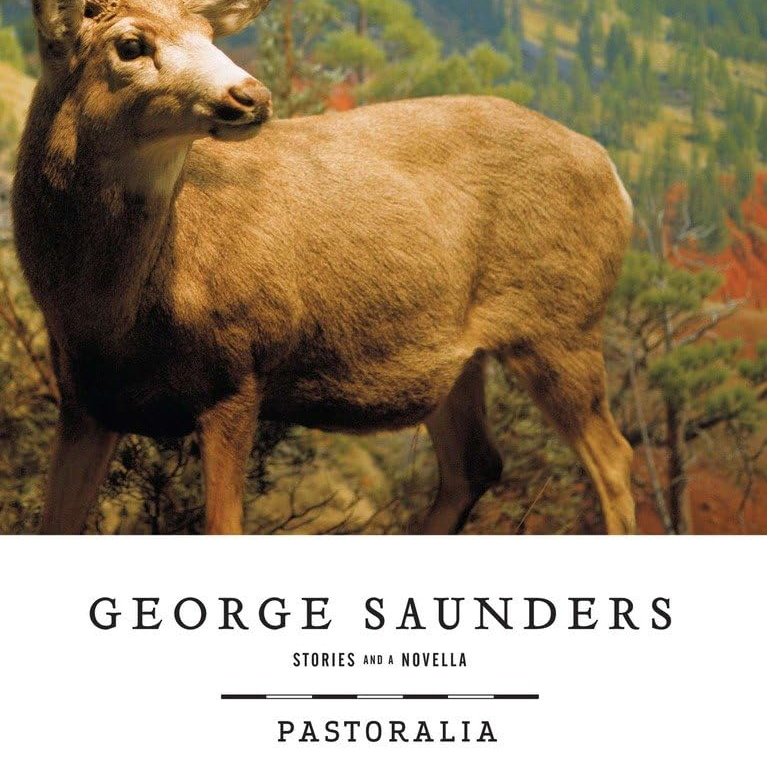
Pastoralia was the funniest thing I read or watched this year, and it wasn’t particularly close. It’s a collection of short stories written by George Saunders, who is my favorite author. His podcasts with Ezra Klein are some of the best interviews I’ve listened to. I read another set of George Saunders short stories called Tenth of December, which I loved. I think Pastoralia is even better. Saunders is so good of writing in a certain style. He writes in this manic, first-person POV that feels like how people actually think.
Did I mention the stories are super funny? The first one tells the story of two people that work at a theme park called Pastoralia. They basically live full-time at the park role playing as cave people. They can never break character. One day, the woman’s no-good son comes to the theme park, asking for money, and the ensuing conversation is hilarious.
“You were torturing a cat,” she says. “With a freaking prod.”
“A prod I built myself in metal shop,” he says. “But of course you never mention that.”
But what makes Pastoralia a master piece is two things. First, all of Saunders’ stories arrive at a certain point, which is our modern-day capitalist system has trapped us in this never-ending cycle. That cycle is tragic, but it can also be hilarious. You’ll find men who refuse to break character as a cave person and male strippers being yelled at by their dead aunt to start showing their cock more. Second, despite the hilarity and tragedy in Saunders’ short stories, he never fails to show the humanity of his characters. The cave person is just trying to make ends meet to pay for his son’s healthcare. The male stripper is just trying to provide for his sisters and their children. We’re all just trying to survive in this cruel world, and Saunders consistently finds the joy, sadness, hilarity and tragedy in the universal experience of living.
Tier Two: It Could be in the Tier Above. It’s Really Good! (8.5 – 9.5)
9. The First Law Trilogy (Book)
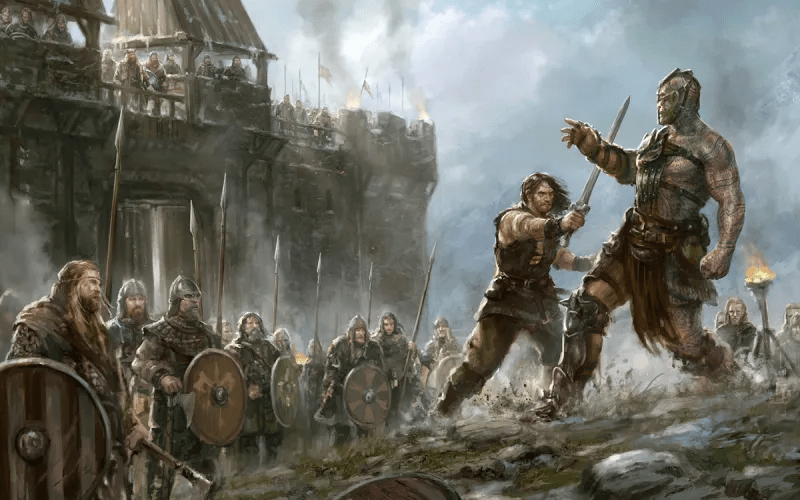
This was a fun one to read. The First Law Trilogy is comprised of three books: The Blade Itself, Before They Are Hanged and Last Argument of Kings. If you’re ever in the mood to read a fantasy series, I would highly recommend checking this out.
There are some similarities to Game of Thrones. There’s an ice world, desert world, middle kingdom type world and old world. However, unlike Game of Thrones, this trilogy does not boast a huge cast of characters. There are basically four main characters we follow: the grizzled warrior from the North, Logen Ninefingers, the crippled inquisition torturer, Sand dan Glokta, the vain young nobleman, Jezal de Luther and Ferro, a deadly Gurkish slave. Each chapter rotates between the four characters, and we get to know them very well by the end of the trilogy.
People say that Game of Thrones is a deconstruction of fantasy stories, but Joe Abercrombie (of A&F???) takes it one step further in the First Law Trilogy. I won’t say much more on the topic, as it’ll spoil some good twists. Abercrombie also writes the best fights I’ve ever read. Logen Ninefingers vs. Fenris the Feared is one of the best one-on-one duels you’ll find in literature.
So why didn’t I put this in tier one? I don’t know. It’s all just made up at the end of the day.
10. The Sympathizer (Book)
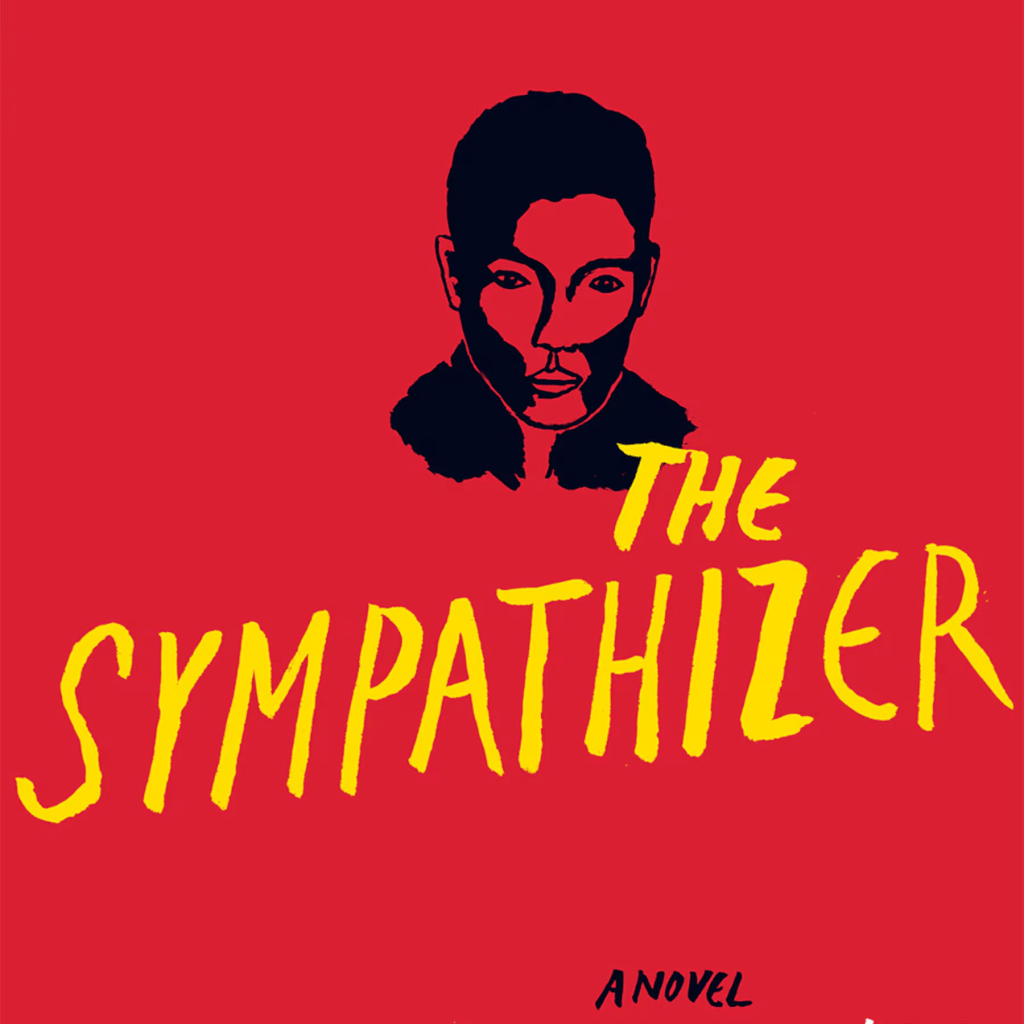
The Sympathizer tells the story of the fall of the South Vietnamese government in the ’70s and the exile of the pro-Western Capitalist Vietnamese population living in exile in Los Angeles. We’re told the story through the eyes of a half-Vietnamese, half-French member of the former South Vietnamese government, who’s actually a undercover double agent for the Vietnamese communist party.
The book is really good. It’s told entirely in a first-person POV, as it’s the confession of this undercover double agent. The main character feels like someone we know very well, but at the same time, is very anonymous. We sit inside the narrator’s head, learning about his conflicting feelings, as he’s forced to live this double life. However, we never get to learn his name. The narrator, someone who’s always led a double life, creates space between himself and his friends, lovers, comrades and even the readers.
My only complaint is I found the book’s writing to be over stylized. It sometimes felt like the author was trying to hard to be slick, using wordy sentences when he didn’t have to. It’s a small complaint, but I prefer the brutal efficiency of Kazuo Ishiguro much more than Viet Thanh Nguyen’s style which feels over written.
Having said that, the below quote is one of my favorite of the year:
“I cannot be the only one who believes that if others just saw who I really was, then I would be understood and, perhaps, loved. But what would happen if one took off the mask and the other saw one not with love but with horror, disgust, anger? What if the self that one exposes is as unpleasing to others as the mask, or even worse?”
11. The Yiddish Policemen’s Union (Book)
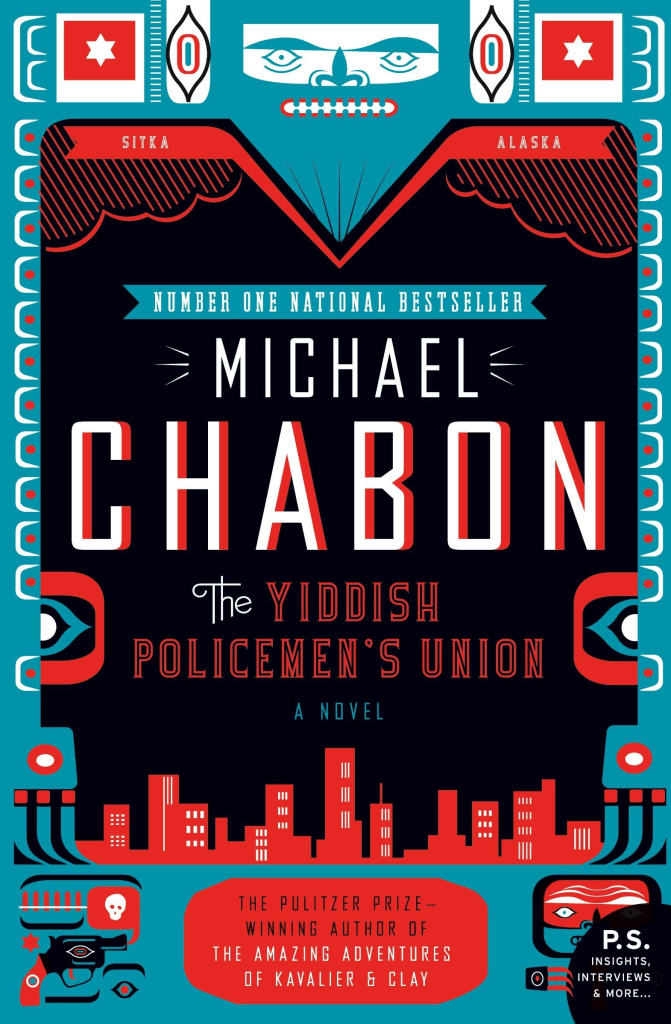
I gave Michael Chabon’s Pulitzer prize winning The Amazing Adventures of Kavalier & Clay a shot earlier in the year, and it didn’t stick for some reason. Not sure why. I liked Chabon’s writing though, so I decided to give another one of his books, The Yiddish Policemen’s Union, a try. I loved it.
It’s a detective story set in an alternative history, where, after World War II, a temporary settlement for Jewish refugees was established in Sitka, Alaska. Chabon creates this incredibly detailed world, a breathing Yiddish-speaking metropolis, which feels so fun to sit in. From the local chess club to the Rebbe-led organized crime family, this fictional place feels so lived in.
The book also reads like a noir-style detective novel. You can almost hear the sad jazz play in the background, as Meyer Landsman, the alcoholic homicide detective with the Sitka police department, tries to investigate the murder of a man in the hotel where Landsman lives. He slowly starts to unravel a mystery that threatens the very existence of the Jewish settlement in Sitka, Alaska.
The reason why I ranked it this low and not in the first tier is because the ending felt like a complete mess to me. The solution to the mystery felt a bit convoluted. However, I loved this line from the book:
“But there was always a shortfall, wasn’t there? Between the match that the Holy One envisioned and the reality of the situation. Between the commandment and observance, heaven and earth, husband and wife, Zion and Jew. They called that shortfall “the world.” Only when the Messiah came would the breach be closed, all separations, distinctions, and distances collapsed. Until then, thanks be unto His Name, sparks, bright sparks, might fly across the gap, as between electric poles. And we must be grateful for their momentary light.”
12. Dandadan (TV Show)
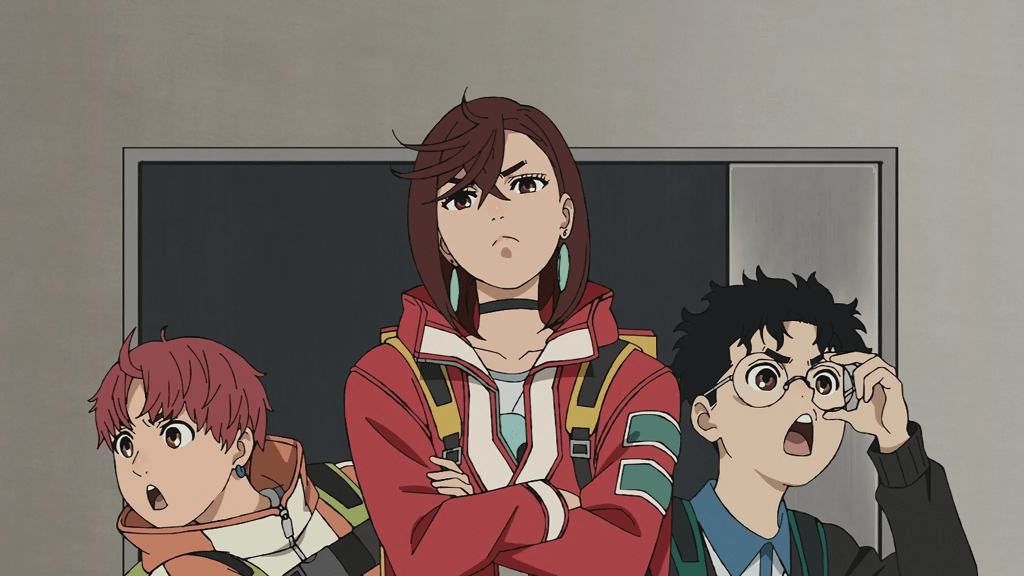
I’m cheating by putting Dandadan on the list because Yasser and I have a couple episodes left of the season, but I felt like I needed to have at least one anime show on my list for 2024. It would feel wrong otherwise. It’s actually the only new anime watched this year.
Dandadan is a lot like Mob Pyscho 100. Soft-spoken high school nerd gets supernatural powers and slowly builds up a crew over the course of the first season. They’re also both very funny shows and have great animation. What sets Dandadan apart from Mob is the romantic relationship between the two main characters, Momo and Okarun. I love a good anime romance, but you almost never see it in the Shounen setting. I also think the author, Yukinobu Tatsu, handles the relationship really well. It progresses naturally over time. The interactions between Momo and Okarun are at once earnest and awkward. The relationship feels real. You laugh at their misunderstandings and can’t help but cheer as they slowly realize they like each other.
The standout episode for me is episode 7. It was probably the best episode of anime I’ve seen in a while. The music and animation were top-notch, but the emotional impact of the mother’s relationship with her child was the highlight of the episode, if not the series.
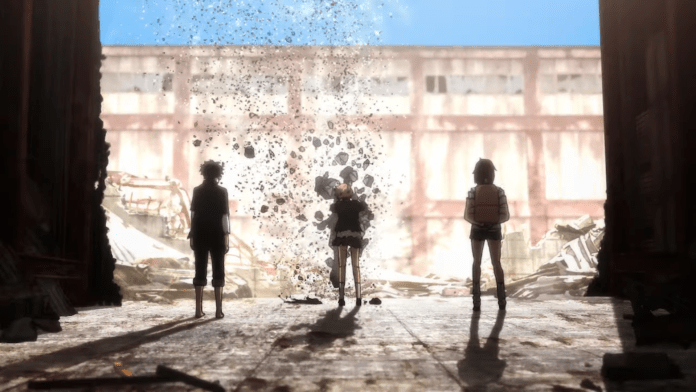
Definitely give the series a watch. The opening is also so catchy.
13. Piranesi (Book)
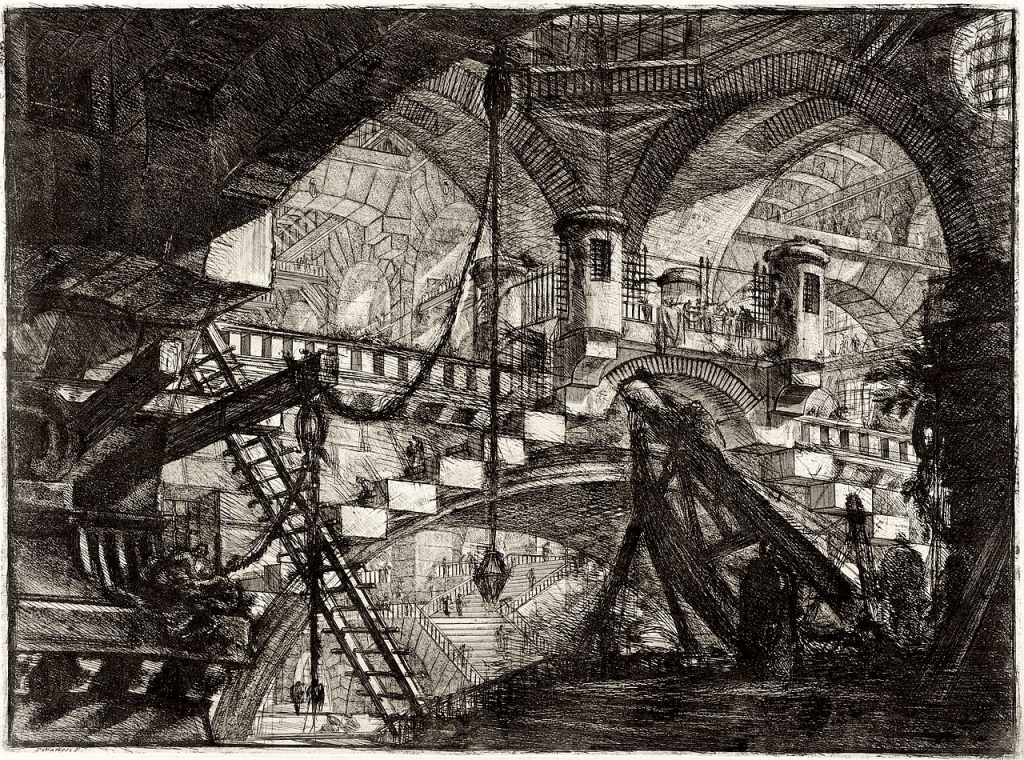
I actually wrote about this novel at the start of the year! So, uhhhh, just read that instead.
14. Titus Groan (Book)
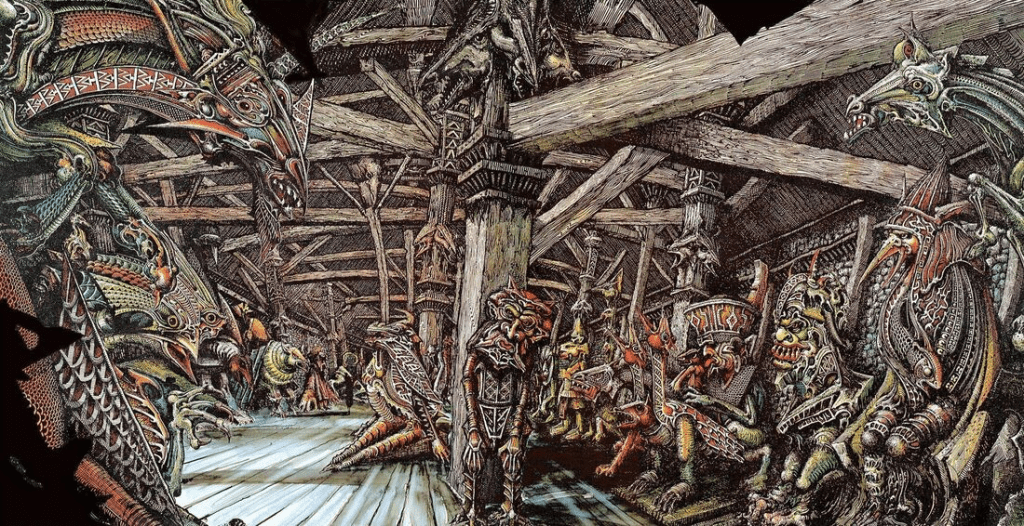
I stole the below from Wikipedia, but I think it’s a good description of the book.
The book is set in the huge castle of Gormenghast, a vast landscape of crumbling towers and ivy-filled quadrangles that has for centuries been the hereditary residence of the Groan family and with them a legion of servants. The Groan family is headed by Lord Sepulchrave, the seventy-sixth Earl of Groan. At the beginning of the novel, two agents of change are introduced into the stagnant society of Gormenghast. The first catalyst is the birth of Titus Groan, the heir to Lord Spulchrave, which interrupts the centuries-old daily rituals which are practiced at all levels of the castle’s society. The second is Steerpike. a ruthlessly ambitious kitchen boy, whose rise to power drives the plot of the book.
The book almost read like a play to me. Characters are exaggerated to such a ridiculous point. You have the identical twin sisters Cora and Clarice, who say almost everything in unison. The horrific cook, Abiatha Swelter, whose kitchen boys almost sing to him in a sycophantic chorus. However, unlike The Sympathizer, the over stylization works perfectly in this book. The descriptions of characters and scenery are lengthy, but it all feels right here.
15. Shogun (TV Show)
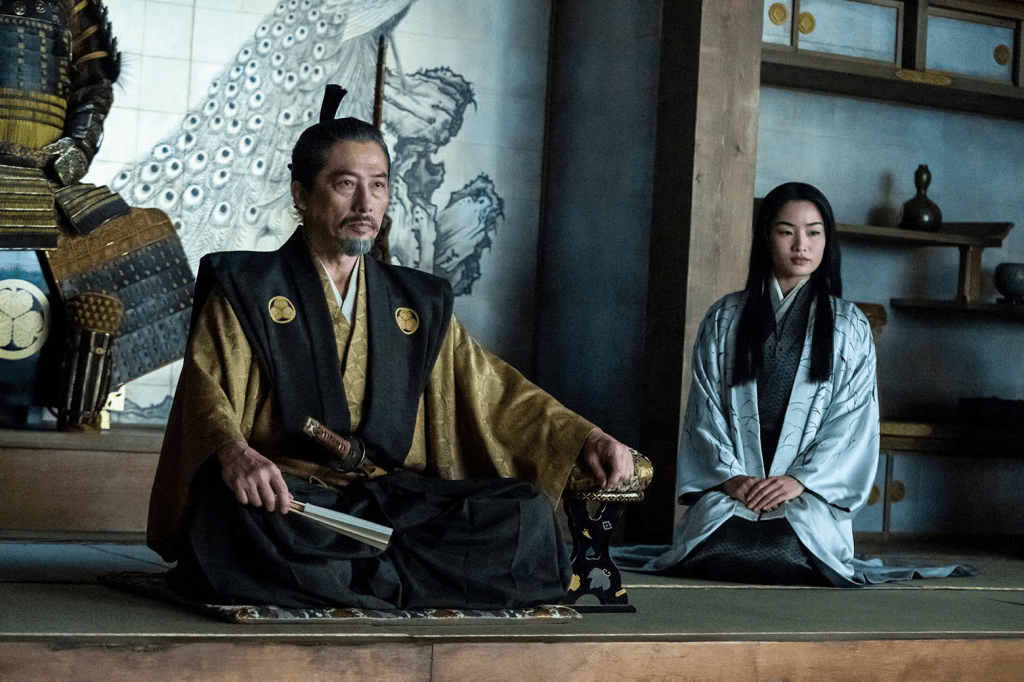
I was skeptical of Shogun going into it. I hate live-action one-hour drama shows that take themselves too seriously. I also heard the book the show was based off of was problematic.
Tiernan and I watched the show during the middle of the year, and it blew away any misgivings I had. It was the best live action TV show I’ve seen in a while. Everyone’s already said this, but it had the political twists and turns of Game of Thrones. The costumes, set designs and music were top notch.
However, in my view, the thing that set the show apart was the acting from Hiroyuki Sanada, Anna Sawai and Tadanobu Asano. Every scene any of them are in is electric. From the opening episode, where Lord Toranaga proudly steps into Osaka Castle, fully aware the other four regents are going to impeach him, thereby condemning him to death, these three characters keep a magnetic pull on the viewers. Sanada and Sawai’s acting is incredibly subtle, using few words and subtle facial ques to convey emotion. Asano, on the other hand, uses over-the-top style that works perfectly for his character.
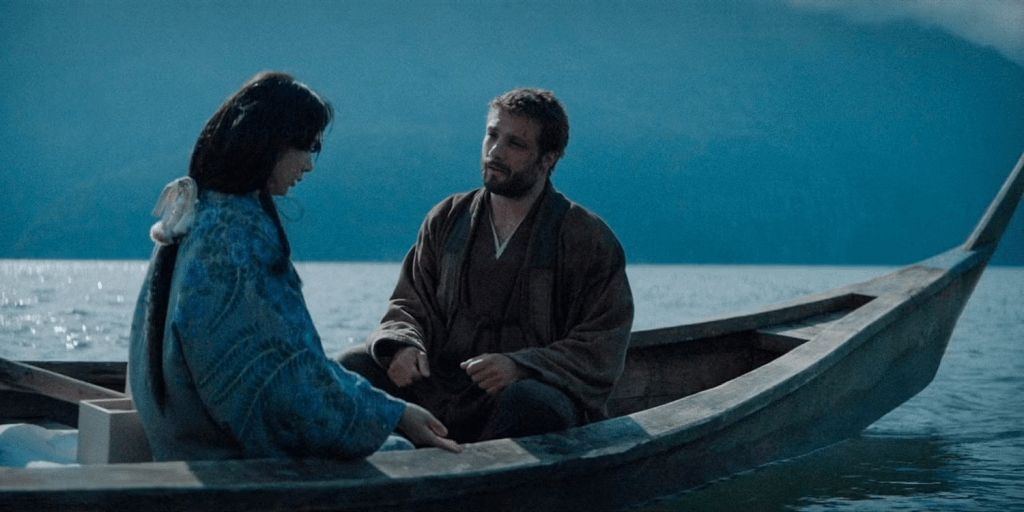
However, my favorite scene from the show didn’t involve any of those characters. It’s at the end of the first season, when Blackthorne takes Fuji, his consort, out on a boat to throw her dead husband and child’s ashes in the sea. It’s an incredibly tender moment for the two characters. The ritual of throwing the ashes over sea becomes this beautiful scene that combines aspects of British and Japanese culture.
16. The Boy and Heron (Movie)
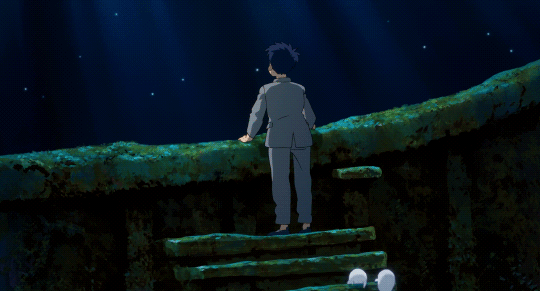
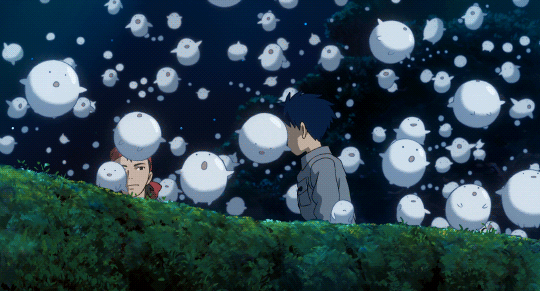
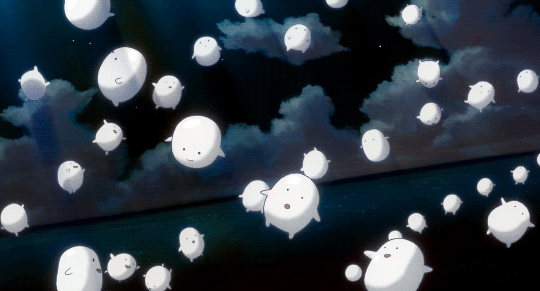
Okay, I fell asleep twice while watching this movie, so maybe I’m not fully qualified to rank it, but from what I remember, it was good! I think the movie is supposed to be an allegory for Miyazaki trying to hand down his film career to his son or grandchildren. Something like that. Apparently, the man-eating parakeets are supposed to represent the capitalistic interests of the film industry.
I guess the reason why I loved this movie was because the other world was so much fun to be in. Words don’t really do it justice. Just look at the sequence below. I mean, come on. What more can you ask for. Blobs!
17. The Handmaid’s Tale (Book)
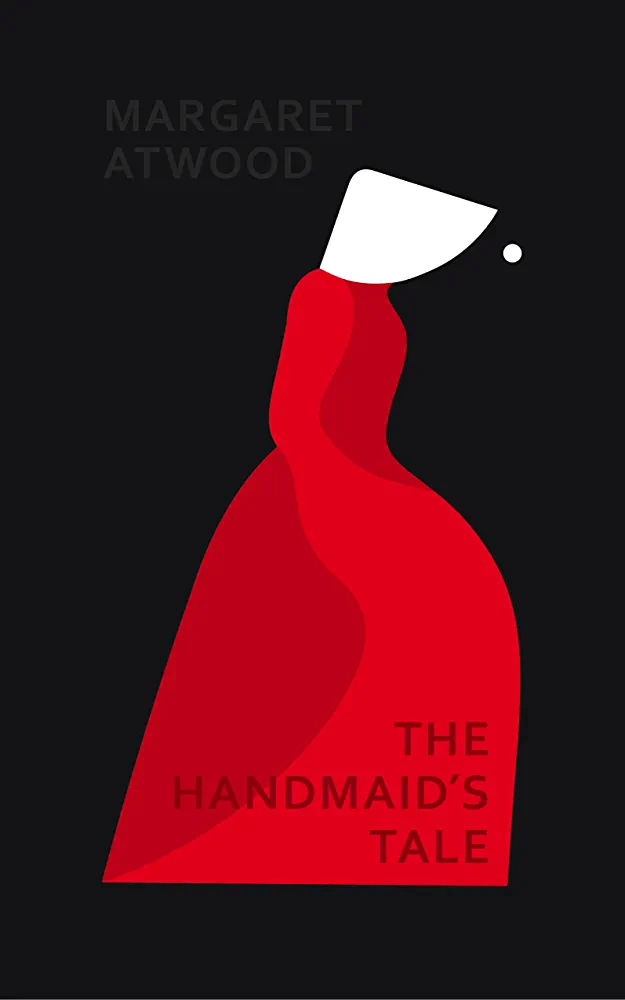
I know a million people have probably already said this about The Handmaid’s Tale, but the story is incredibly prescient for the time we’re living in right now. Not to be dramatic, but it felt chilling reading this book. I won’t give a summary overview because you probably know what it’s about.
A couple things stood out to me about the book. The first is Margaret Atwood’s writing is really good. It probably seems obvious, but I think it’s worth mentioning that her sentences feel meticulously crafted when you’re reading them. She doesn’t waste words or punctuation. The second is Atwood’s story is mostly about the events that precipitated Ofred’s new life in the Republic of Gilead. In my mind, Atwood isn’t telling a story about what a patriarchal, totalitarian and theocratic country would look like and more wants to detail the signs that lead up to it. Because once it’s happened, you can’t unwind it. The book burnings. The Christian daytime television. The slow restriction of women’s rights. It all feels like stuff you see nowadays. Stuff we normalize.
Well, anyways, the book is definitely worth a read. I haven’t watched the tv show, but would highly recommend the book.
18. Iron Claw (Movie)
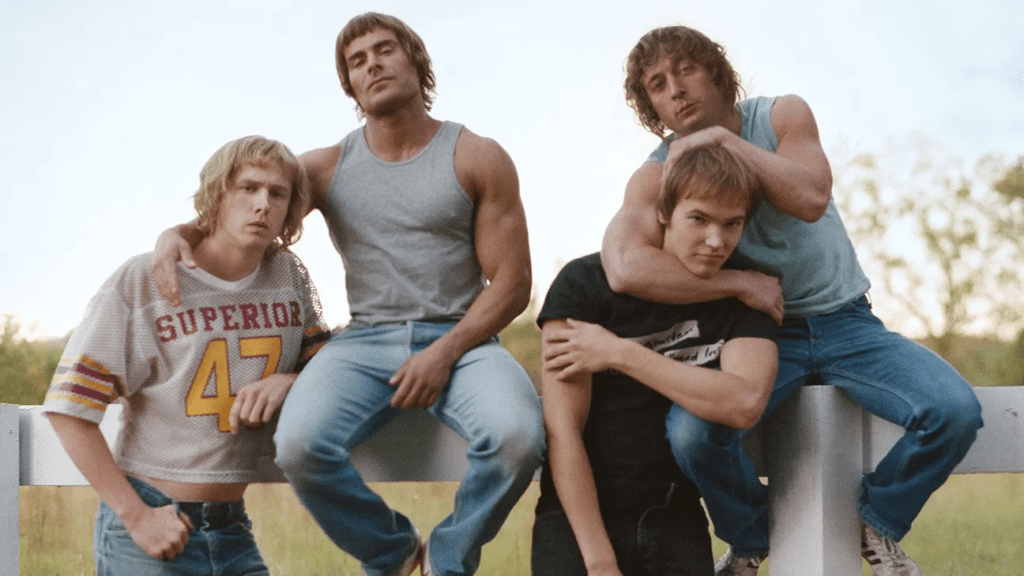
I feel bad putting this movie so low on the list. I think I watched it with Tiernan in the middle of the year.
Anyways, the true standout of this movie is Zac Efron as Kevin Von Erich. He’s so good here. Efron does this lost puppy dog eye thing, particularly when he’s around their father, Jack Von Erich, that conveys so much emotion. You can tell he’s a good guy who’s loves his family. He will do anything to please his father and protect his siblings, and the increasing incompatibility of those two things tears him apart. I think the movie is worth watching if only for his performance.
Tier Three: It’s Good But I Do Have Some Complaints (7.5 – 8.5)
19. Dom Casmurro (Book)
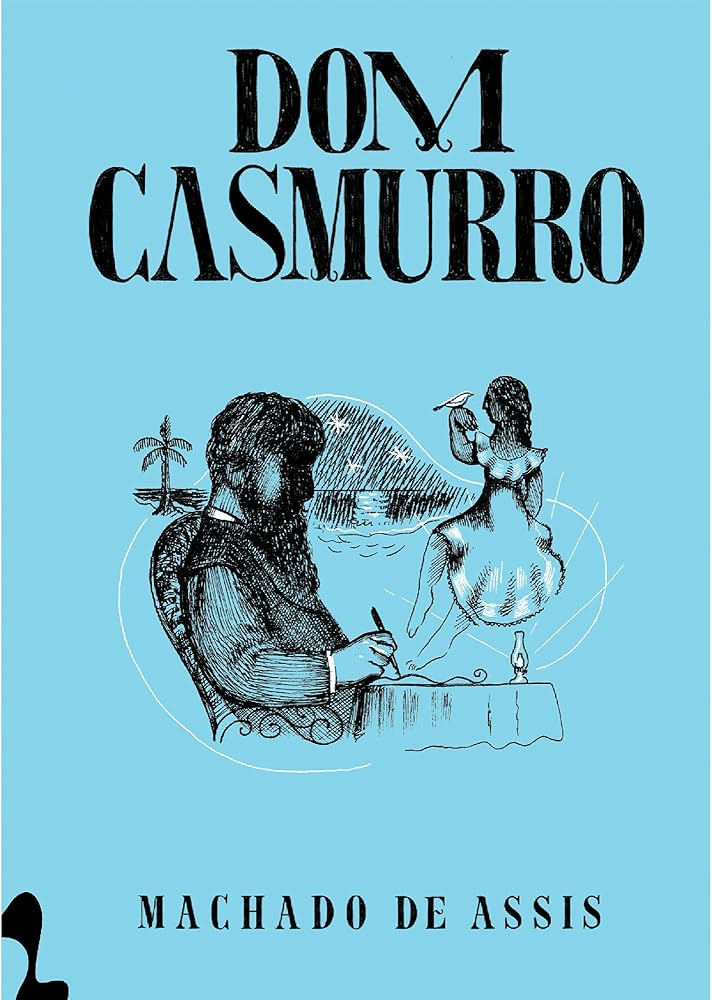
I picked up this book because some random Youtuber recommended it. I thought it was pretty good. I don’t really have any complaints about it, but it wasn’t memorable. I think it probably deserves a few re reads. The book tells the tale of Bento Santiago, an elderly man living in Brazil during the turn of the end of the 19th century. He’s recounting his life, from childhood until now.
Santiago falls in love with his childhood friend, Capitu, and they eventually get married and have a child together. However, Santiago eventually comes to suspect that his wife had an affair with his best friend, the now-dead Escobar. He even comes to believe his child isn’t his. As a result, he leaves his wife and estranges himself from her and his child. We are told this story entirely from Santiago’s perspective, and it becomes clear he’s a biased, and even perhaps an unreliable, narrator. We start to question little details that he throws in about Capitu, particularly at childhood.
I may try to read this book again and see if it’s a more rewarding experience upon re read.
20. The Wall (Book)
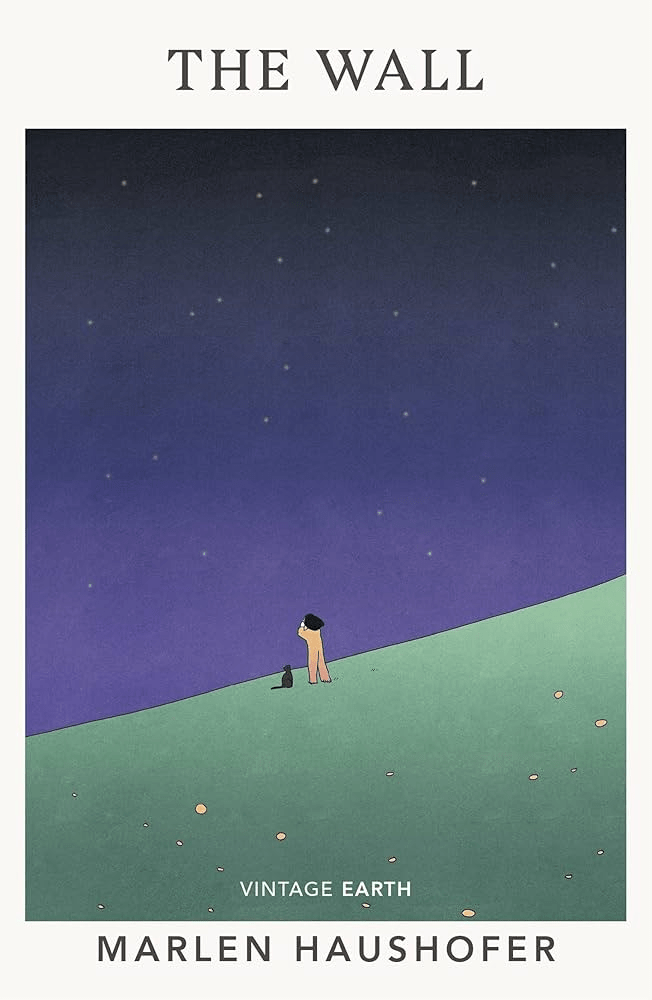
The Wall is a book written by Marlen Haushoffer. I’m going to steal Wikipedia’s description of the book because at this moment, I’m feeling too lazy to come up with something myself.
The novel’s main character is a 40-something woman whose name the reader never learns. While vacationing in a hunting lodge in the Austrian mountains, a transparent wall has been placed that closes her off from the outside world; all life outside the wall appears to have died. With a dog, a cow, and a cat as her sole companions, she struggles to survive and to come to terms with the situation. Facing fear and loneliness, she writes an account of her isolation without knowing whether or not anyone will ever read it.
So there you go. It’s a pretty good book. The only reason I’m putting it this low is because it wasn’t that memorable to me. Like it was good. I liked the woman’s relationship with the her dog and two cats. Especially the cats. I like cats. This one might deserve a re read at some point as well. It’s kind of like a better, adult version of the book Hatchet. Did you read that as a kid? I loved that book growing up. Did you know that there are five sequels to Hatchet? That’s kind of absurd. It really should have been a one-and-done book.
Getting back to The Wall, I thought the book was good. Would recommend.
21. Tomorrow, and Tomorrow, and Tomorrow
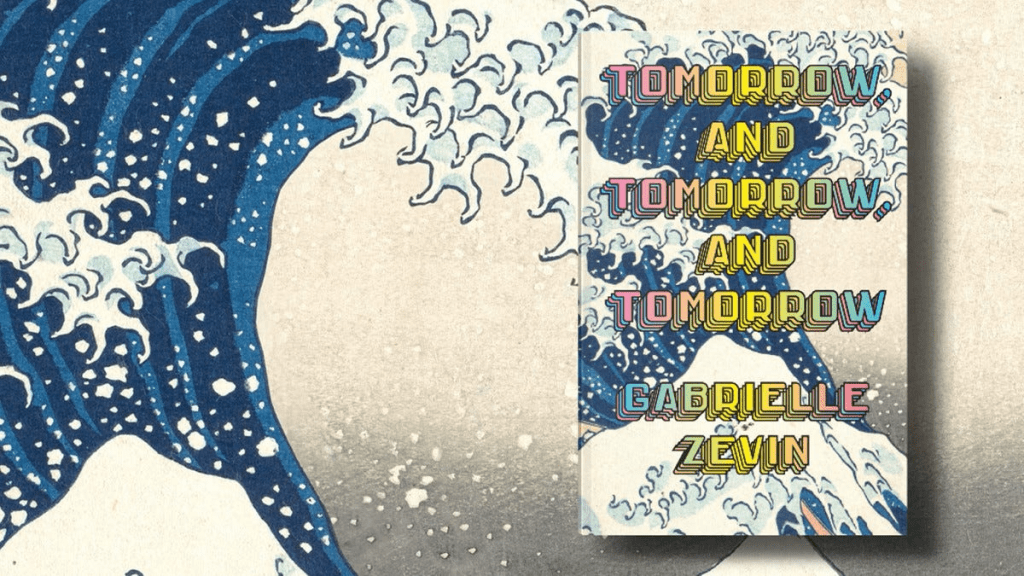
Again, I’m going to steal a description from Wikipedia.
Set over the course of several decades, this book follows video game developers Sadie Green and Sam Masur, childhood friends who reunite while both studying at college in Boston. The thing that makes this book is the love of video games, and the deep friendship between Sadie and Sam.
The thing with relationships, particularly friendships, is they ebb and flow. Sometimes you’re texting every day, hanging out with them once a week. Other times, it’s so rocky that you don’t speak to them for four years. Nothing’s guaranteed with friendship. It’s about the effort and care the two people put into the relationship. As we grow older and situations change, that effort and care needs to be constantly adjusted. And then other people and situations can enter into and disrupt an existing friendship. New significant others. New friends. People moving. Friendship can be difficult, but it’s also so rewarding. This book gets that.
I loved the last scene in the novel. Sadie and Sam, now decades into their friendship, say goodbye at the airport. At the top of his lungs, Sam screams the line that’s been with them the entire time. The line that only long-term friends can appreciate. The line that started the whole book.
“SADIE MIRANDA GREEN,” he shouts, “YOU HAVE DIED OF DYSENTERY“
So what are my complaints? It’s hard to put my finger on it. I feel like the story could’ve been a lot tighter. I think the author could’ve chopped off a hundred pages.
Tier Four: Flawed Work That Had Some Good Parts (6 – 7.5)
22. Dune 2 (Movie)
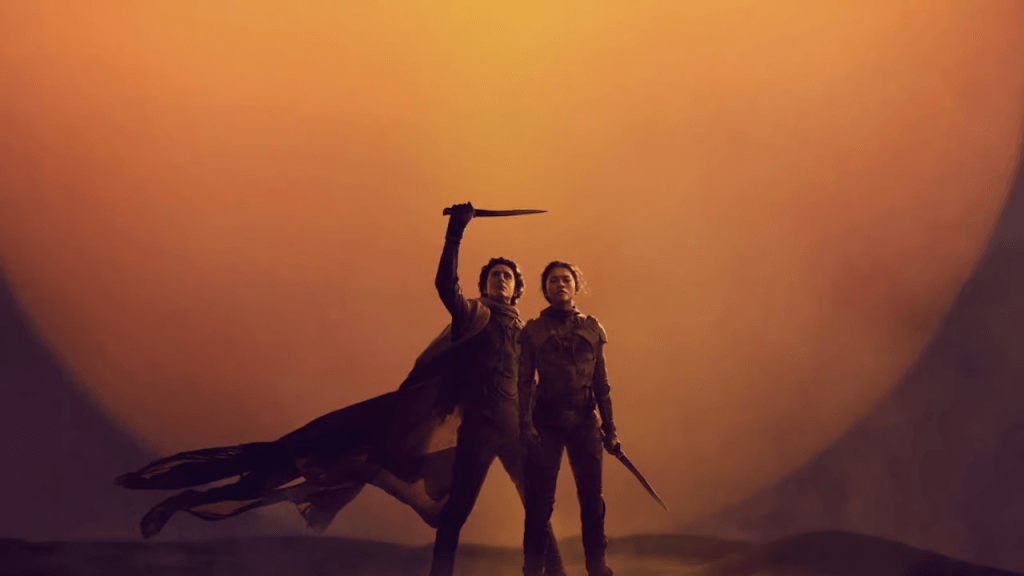
I don’t have much to say about this one. I thought the movie was fine. Really good costume designs, cinematography and sound design, but I had two problems. The first is I fundamentally don’t like Frank Herbert’s story. I really don’t appreciate that it’s basically about a white savior prince coming to a bunch of brown people to save them and become their god. I’m not someone who cares that much about diversity and political correctness in stories, but like come on.
Second, I really did not like some of the changes they made from the book to the movie. The final battle felt anti-climatic, and I hate that they didn’t include Paul’s sister, Alia. She was such a fun, weird element in the second half of the book.
23. Friday Black (Book)
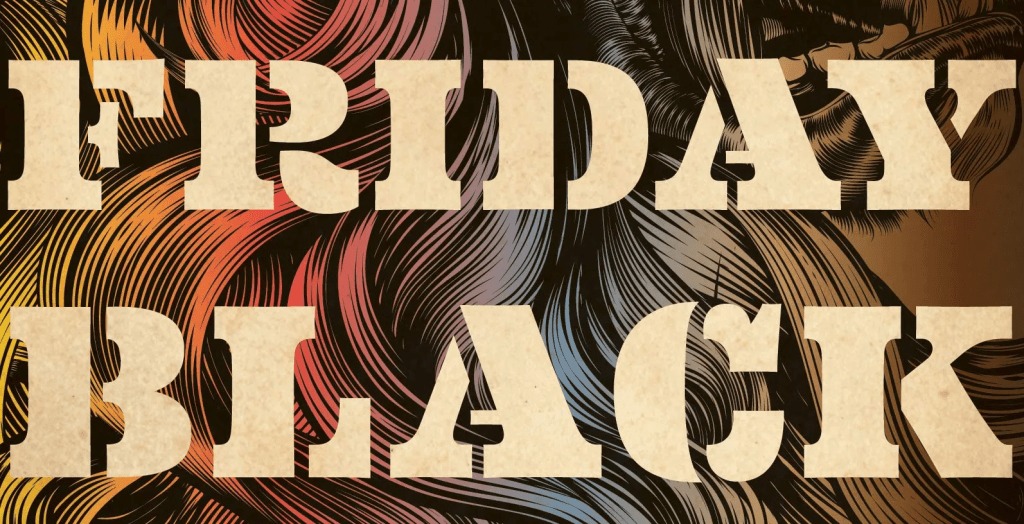
I randomly picked up this book in a store when my parents and I were exploring Vancouver earlier in the year. I told the lady at the register I liked sci-fi and dark humor, so she pointed me to Nana Kwame Adjei-Brenyah’s Friday Black. It’s a collection exploring black identity in a near-future, usually dystopian setting. Brenyah studied under George Saunders, who’s one of my favorite authors, so I was really excited to read this.
I think most of the short stories were okay. My biggest problem with most of them is I felt like I was reading someone trying to imitate the style of Saunders. You can tell Brenyah was trying to be funny in the way that Saunders is funny, but it’s such a hard style to replicate. Saunders has this way of writing that makes you feel like you’re truly in someone’s head as they constantly trip over their manic thoughts.
The other issue I had is I felt like Brenyah’s stories were too explicit with their anti-capitalistic takes. Saunders does a really good job critiquing our modern-day society by just showing the depressing hamster wheel we’re all on. Brenyah’s stories were a bit too on-the-nose for me. For example, there’s a short story where we get the perspective of a retail salesperson, who has to defend against zombie-like customers on Black Friday. Like, I get it.
The one short story I really enjoyed was Through the Flash. It tells the story of a 14-year old girl and her suburban community that’s been trapped in a daylong infinite loop that always ends with a nuclear explosion that kills everyone, only to reset and start the day all over again. Through the infinite loop, the main character has accumulated super strength and speed and is now known as the Knife Queen for her skills of mass murder in her town. It’s a super fun, whacky story, and there’s this line from it I found to be super beautiful:
“Then, I’m on a bike, and Ike is sitting in front on the handlebars, and we’re riding in the wind like we’re unstoppable beings who truly have all anyone could ever hope for.”
I don’t know. There’s just something I really like about that line.
24. Ancillary Justice (Book)
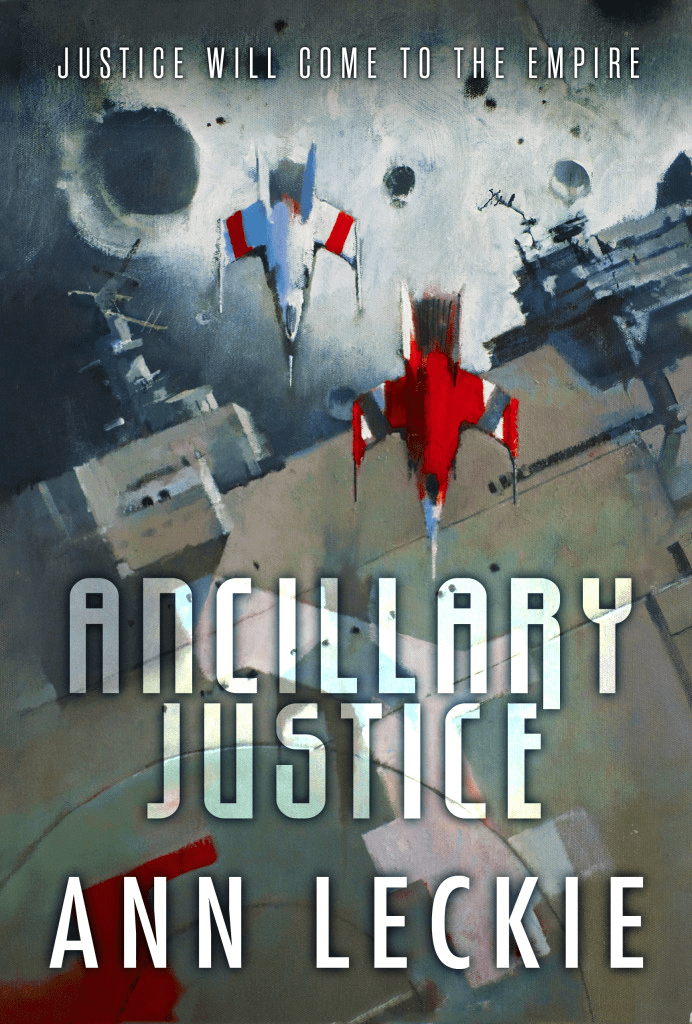
I’m annoyed because I wanted to like this novel more than I did. It’s a space opera that follows Breq, who served as the artificial consciousness of a military spaceship, Justice of Toren, under the Radch Empire. The story is also told in a non-linear fashion. It really does have all the elements that I look for in a novel, but this book fell a bit flat for me.
The book suffered from a few problems. The first is it was hard to care about a lot of the characters. Breq was obviously not human, so that was always something to consider, but I still felt like it was hard to understand the characters’ motivations, particularly at the start of the novel. The second issue is the big reveal of the book is there is a covert war going on between two cloned versions of the Lord of the Radch, Anaander Mianaai. It’s honestly really hard to follow, and for the last part of the book, I felt like I was reading the Spider-Man pointing fingers meme. I don’t think a book should be considered bad because it’s big reveal was disappointing, but it felt convoluted and made the last part a slog to get through.
I think the book has some interesting ideas about gender, AI and colonization, but for me, it didn’t hit the mark.
Tier Five: I Wouldn’t Spit on it if it Were on Fire (No Score. Doesn’t Deserve One)
25. 3 Body Problem (TV Show)
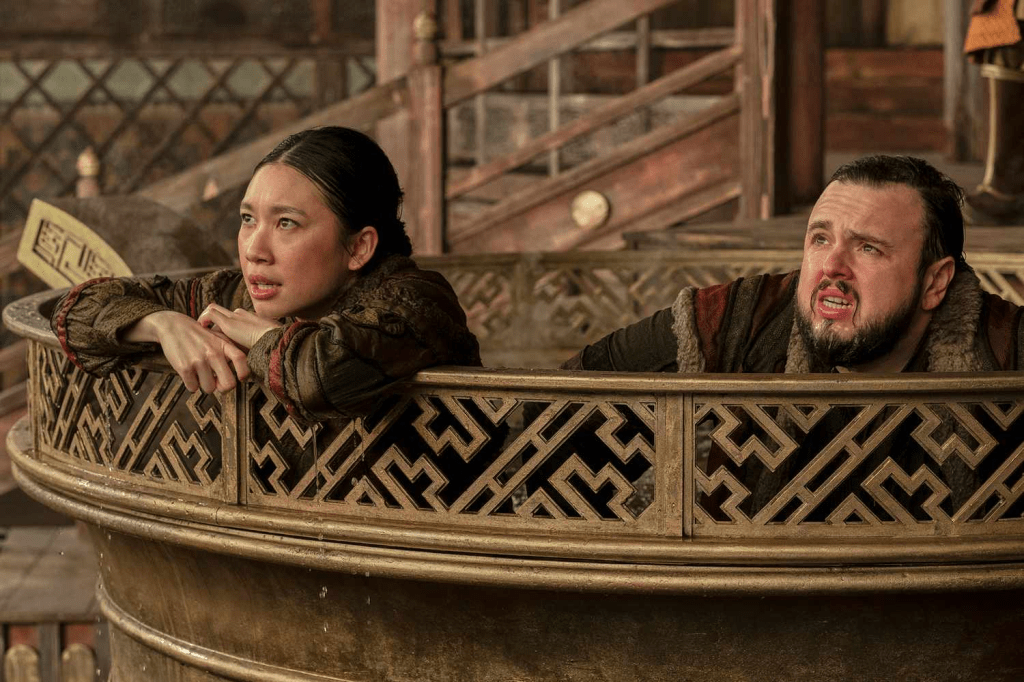
Michelle, if you’re reading this, I’m sorry you’re seeing the placement of 3 Body Problem so low, but this is the TV show and not the book! I thought this show was so bad. The acting was terrible, the dialogue had that classic post 2010 “serious drama” TV show problem of being quippy but not like how real people talk and the cinematography was uninspired (sorry, I know that last part sounded pretentious).
The TV show did nothing to make me care about the friendship between the Oxford 5. They expected us to understand how deep of a relationship these five former students had together, but didn’t do anything to earn it. I found Liam Cunningham as the Chief of MI6 to be unbearable to watch. He would just say random snarky things, and the entire time I’d be thinking, who are you and why should I care about you? It basically felt like David Benioff and D.B. Weiss took some of their favorite side characters from Game of Thrones (Davos and Sam Tarly) and were like, errr yeah, why don’t you guys kind just do something in this TV show too?
This might be a problem with the book, but I found some of the plot points to be so weird. For example, the San-Ti aliens completely turning on the people on Earth supporting them after they find out humans lie felt so out of place. These people have been talking to the San-Ti for decades now. How are they just finding out, through this casual phone conversation, that humans lie? Also, at the end of the season, when they take Jovan Adepo’s character and are like, so yeah, you’re going to be one of the three humans on Earth who have to come up with a plan to defeat the all-powerful alien force with only your own mind. Like why? What has this dude done to be afforded that responsibility? It makes no sense.
I’m getting frustrated just writing about it. Netflix, David Benioff and D.B. Weiss should feel bad about this whole project. Do better.


